Self-awareness & relationships
Acceptance Is Not Approval

Acceptance is one of those words that appears everywhere in conversations about healing, relationships and personal growth, yet it is surprisingly easy to misunderstand. It can sound passive, as though acceptance means deciding that something is fine, letting go of your standards or making peace with circumstances you would much rather change. In the Relationship Sanity context, acceptance means something more demanding than that: being willing to see reality clearly, including the parts of reality you wish were different.
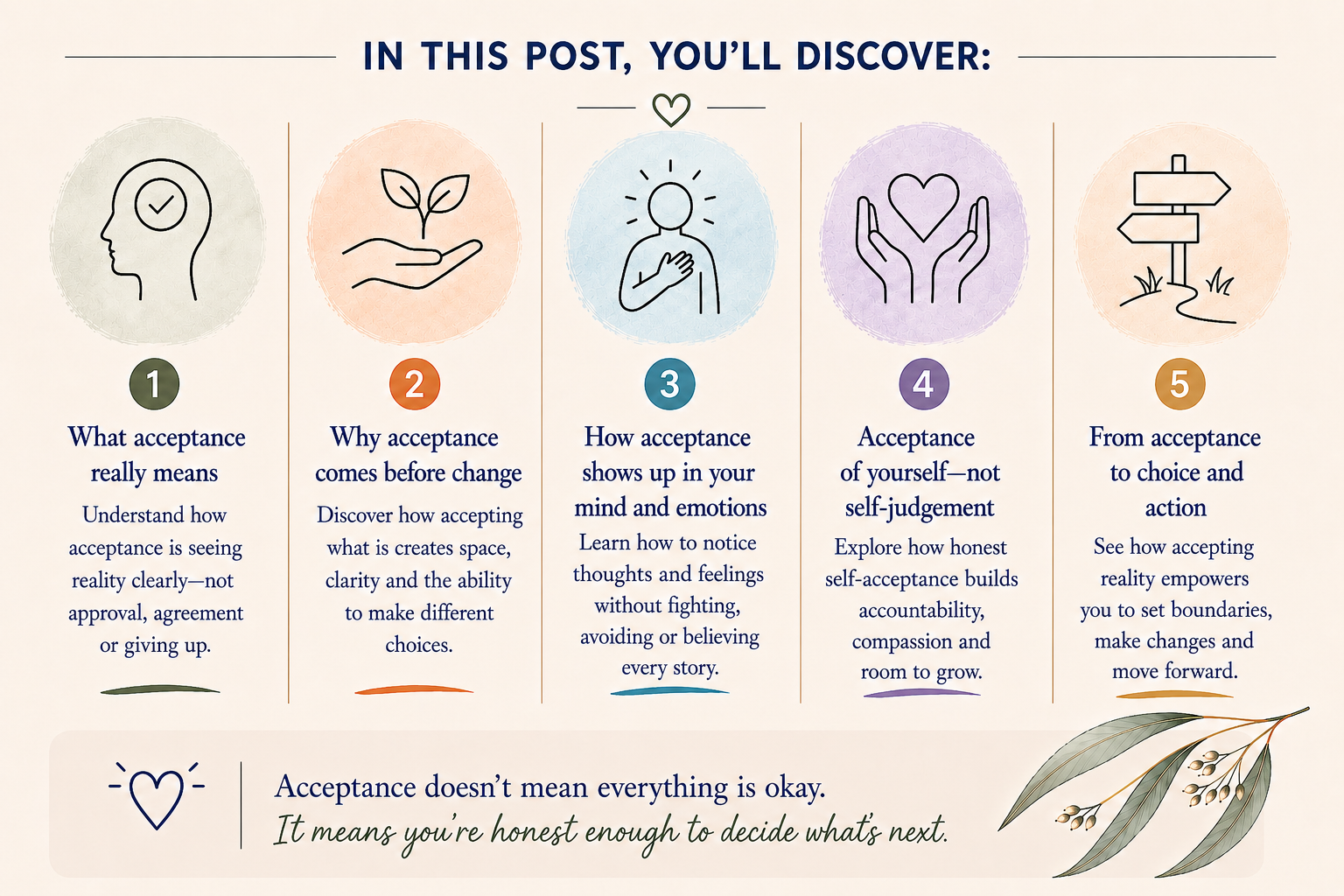
That might mean acknowledging that a relationship was painful, that someone behaved in a way that hurt you, that a pattern has continued longer than you wanted to admit, or that you made choices you now regret. It can also mean accepting something about yourself that is difficult to look at honestly. None of this requires approval, forgiveness, agreement or resignation. Acceptance begins with a willingness to stop arguing with the fact that something happened, or that something is happening, so that you can decide what to do with the reality you actually have.
Acceptance comes before change
There is a practical reason acceptance matters when we are trying to change something: it is difficult to change what we are unwilling to acknowledge. If you keep telling yourself that a relationship isn’t really hurting you, you have very little information to work with when deciding what needs to change. If you minimise a pattern because acknowledging it feels too uncomfortable, you may continue participating in it without fully recognising what is happening.
The same thing can happen internally. Perhaps you are angry, disappointed, frightened or deeply hurt, but you have decided that you shouldn’t feel that way. You may then spend more energy arguing with the emotion than understanding what it is telling you about your experience, your expectations or your values. Acceptance doesn’t require you to conclude that the emotion is right about everything; it simply allows you to acknowledge, This is what I am feeling right now.
That is a much more useful starting point than pretending you aren’t where you are.
Once you can acknowledge where you are, you can begin thinking about where you want to go. Acceptance gives you something solid to work with because you are no longer trying to make decisions from a version of reality that has been edited to make it more comfortable.
Acceptance is not giving up
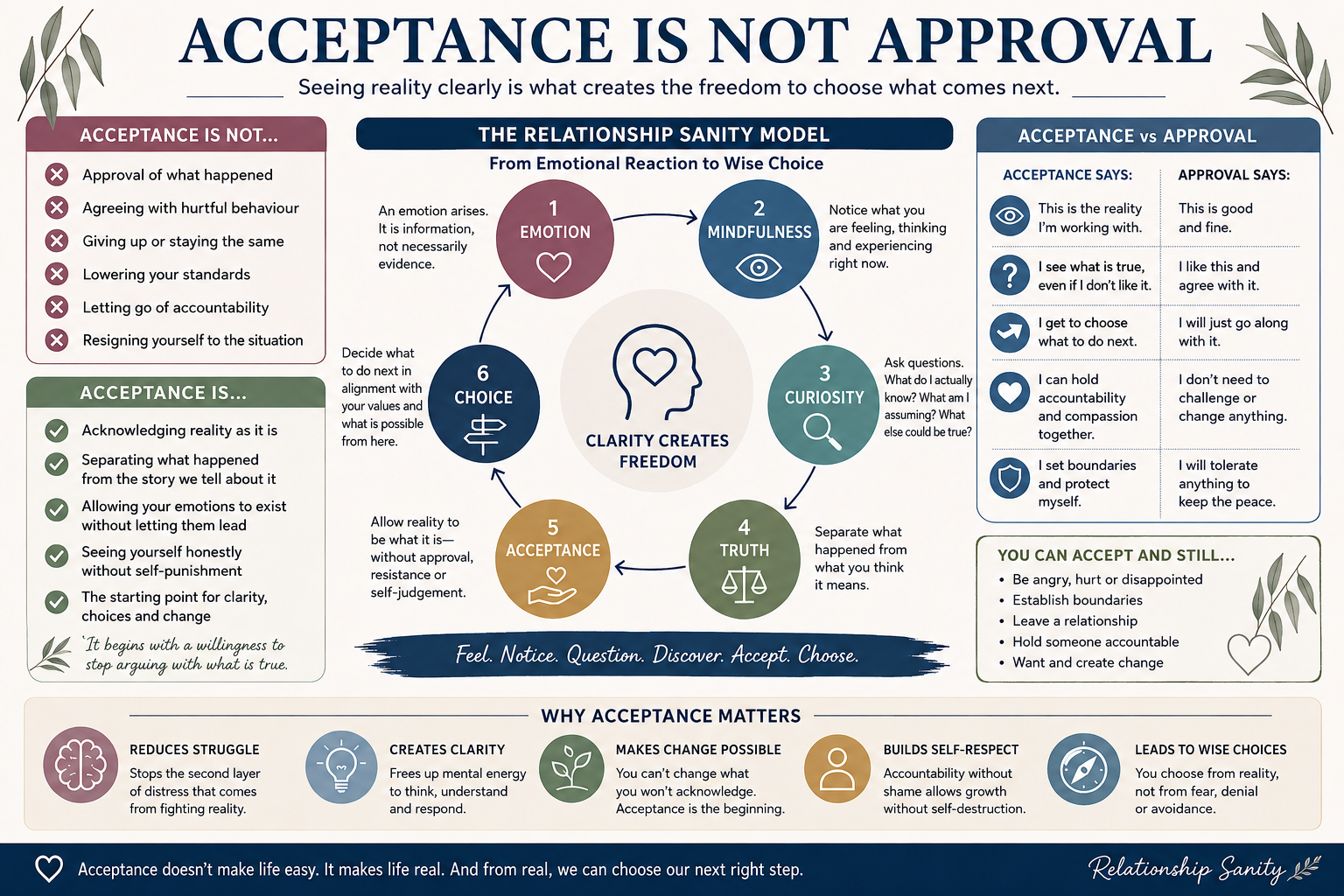
Acceptance can sometimes feel like surrender, particularly when the thing we are accepting is painful. There is a significant difference, though, between accepting reality and deciding that nothing can be done about it. Giving up says, “There is nothing I can do,” whereas acceptance says, “This is the reality I am working with, and I need to decide what is possible from here.”
You can accept that someone treated you badly and still decide that you deserve something different. You can accept that a relationship has changed while grieving what it once was, or accept that someone may never give you the apology or explanation you wanted while deciding what you need to do for yourself. You can also accept that you made a mistake without deciding that the mistake tells you everything there is to know about who you are.
Acceptance doesn’t remove agency. If anything, it gives you a clearer place from which to use it.
Reality and the story we tell about it
Sometimes what makes acceptance difficult isn’t only what happened. It is what our minds immediately begin telling us that the event means, because human beings are remarkably quick to fill gaps in information with explanations that feel convincing, particularly when something important to us is at stake.
Someone becomes distant and you think, They don’t care about me. A relationship ends badly and you think, I must have done something wrong. Someone treats you poorly and you wonder whether you are overreacting. Or perhaps you keep searching for the explanation that would make everything make sense: If I could just understand why they did it, maybe I would know what to do.
There is nothing inherently wrong with wanting to understand. Curiosity can be extremely useful, but it can also become another way of avoiding reality when we use endless explanations to postpone accepting what we already know. Acceptance invites a slightly different kind of attention: What actually happened? What is happening now? What am I feeling? And, perhaps most importantly, what do I know rather than what am I imagining?
That distinction doesn’t necessarily give you an easy answer. It can, however, prevent the story around an experience from becoming more certain than the experience itself.
Acceptance starts with yourself
Acceptance isn’t only about accepting other people or circumstances that you cannot control. Some of the hardest things to accept are things about ourselves: the choices we regret, the boundaries we didn’t have, the patterns we tolerated, the moments when we ignored our instincts, or the parts of our personality we would rather not have to examine.
Self-acceptance doesn’t require you to decide that every choice you’ve made was reasonable or that every part of yourself is something you want to keep. It means being honest enough to acknowledge where you have been without using shame to make sure you never move beyond it. You might say, “I made that choice,” or “I stayed longer than I wish I had,” while also recognising, “I didn’t understand the pattern at the time, and I was trying to protect myself with the resources I had.”
There is an important difference between accountability and self-punishment. Acceptance gives you the possibility of practising the first without becoming trapped in the second, because you can acknowledge what happened without making the past a permanent verdict on your character.
Acceptance creates room to think
When we stop spending quite so much energy fighting reality, something interesting can happen: there is more room for thought. You may have been using enormous amounts of mental energy trying to convince yourself that something isn’t happening, that you shouldn’t feel what you feel, or that the past could somehow be changed if you examined it from enough different angles.
Once you acknowledge the reality, the question can become more useful. Rather than asking, How do I make this not be true?, you can begin asking, Given that this is true, what do I want to do now? That doesn’t mean the situation has become easier, and it doesn’t mean you have suddenly accepted it emotionally in every sense of the word. It simply means you have stopped requiring reality to become different before you are willing to respond to it.
This is one of the reasons acceptance can be associated with clarity. You can see what is happening, recognise what you are feeling and begin considering what choices are available without first having to resolve every uncomfortable part of the experience.
Acceptance in psychological approaches
Acceptance isn’t simply a comforting idea about learning to let things go. It has an important place in several established psychological and therapeutic approaches, although different approaches use the concept somewhat differently. At Relationship Sanity, acceptance means developing the capacity to acknowledge thoughts, feelings, experiences and circumstances as they are, without automatically fighting them, avoiding them or allowing them to dictate our behaviour.
That distinction matters because psychological distress can sometimes become more complicated when we are constantly trying not to experience what we are experiencing. Anxiety about feeling anxious, shame about feeling angry, or fear of being sad can create a second layer of distress around the original emotion. Acceptance doesn’t necessarily remove the first feeling, but it can reduce the additional struggle involved in trying to make the feeling disappear before we can continue with our lives.
Acceptance and Commitment Therapy
Acceptance is one of the central ideas in Acceptance and Commitment Therapy, commonly known as ACT. ACT recognises that difficult thoughts and emotions are a normal part of being human, and its focus is not on eliminating every uncomfortable internal experience before a person can live according to their values.
In this context, acceptance might look like recognising, “I am feeling anxious, and I can still take the next step.” The alternative is the assumption that action has to wait until the anxiety disappears, which can leave us organising our lives around avoiding uncomfortable internal states. Acceptance allows the feeling to be present without automatically handing it control over what we do.
That doesn’t mean enjoying the emotion, agreeing with every thought that appears or remaining passive when circumstances need to change. It means becoming more capable of making choices while difficult internal experiences are still there.
Acceptance and Dialectical Behaviour Therapy
Acceptance is also an important part of Dialectical Behaviour Therapy, or DBT, particularly through the concept of radical acceptance. Radical acceptance involves fully acknowledging reality as it is, particularly when the reality is painful and cannot be immediately changed.
This can be difficult because our minds naturally protest against painful circumstances. This shouldn’t have happened. This isn’t fair. They shouldn’t have treated me this way. I can’t believe this is my reality. Those reactions make sense, especially when something genuinely unjust or painful has occurred, but repeatedly arguing with an unchangeable fact can add another layer of suffering to the original experience.
Radical acceptance doesn’t mean approving of what happened or deciding that it was acceptable. It means recognising that it happened and that the fact of its having happened cannot be undone. From there, the question becomes what you want to do with the reality that remains.
Acceptance and mindfulness
Acceptance is also closely connected with mindfulness, which involves paying attention to present-moment experience with greater awareness and less automatic judgement. That might include noticing what you are feeling, what thoughts are appearing, what is happening in your body, what you want to avoid and what is actually happening around you.
One small distinction can make a considerable difference. I’m noticing the thought that they don’t care about me is not quite the same as They don’t care about me. The first recognises an internal experience; the second presents the thought as an established fact.
That doesn’t mean the thought is wrong. It simply means there is value in recognising the difference between something occurring inside your mind and something you know about the external world. Acceptance allows the thought to be present without requiring you to immediately believe it, suppress it or act on it.
Acceptance and Cognitive Behavioural Therapy
Acceptance isn’t necessarily the primary goal of Cognitive Behavioural Therapy, but the two approaches can complement each other. CBT often involves examining patterns of thought, considering the evidence for an interpretation and exploring whether a particular way of thinking is accurate or helpful, while acceptance can provide the willingness to acknowledge the thought before we begin examining it.
For example, you might notice, “I automatically assume people are angry with me when they become quiet.” Acceptance doesn’t mean deciding that assumption is true. It means becoming willing to recognise that this is a pattern your mind produces, rather than immediately defending yourself against the thought or pretending it isn’t there.
From there, curiosity can do its work. You can ask whether the thought is supported by evidence, whether there are other plausible explanations and what tends to happen when you believe it. Acceptance allows you to stop fighting the fact that the thought is occurring; cognitive examination can then help you investigate whether the thought deserves to be believed.
Acceptance does not mean accepting harmful behaviour
This distinction is important enough to state plainly because the language of acceptance can become confusing when we are talking about relationships. Psychological acceptance concerns our relationship with reality and our internal experience; it does not require us to approve of everything that happens to us or tolerate behaviour that is harmful.
You can accept that someone is behaving disrespectfully and still establish a boundary. You can accept that a relationship is unhealthy while deciding whether there is anything meaningful to repair. You can accept that someone has hurt you and decide that they no longer have access to you, just as you can accept that you are angry without allowing the anger to determine how you behave.
Acceptance doesn’t ask you to become passive. It asks you to stop requiring reality to be different before you are willing to acknowledge what it is.
From acceptance to choice
This is where acceptance becomes particularly useful. Once we stop spending all our energy fighting the reality of what has already happened, some of that energy becomes available for considering what is possible now.
The question can move from How do I make this not be true? towards Given that this is true, what can I do next? Sometimes the answer will be to stay and repair something. Sometimes it will be to establish a boundary, leave a relationship, grieve what has been lost or simply stop fighting yourself about an emotion that is already present.
That is psychological flexibility in a practical sense: being able to acknowledge what is happening without requiring that acknowledgement to determine a single predetermined response. Acceptance doesn’t tell you what choice to make. It gives you a clearer relationship with the reality from which you are making it.
Acceptance and shame
Shame complicates acceptance because shame doesn’t simply say that something happened or that we behaved badly. It can turn an experience into an identity. Instead of I did something I regret, the mind moves towards I am a bad person, and instead of I stayed in a relationship that wasn’t healthy for me, it becomes There is something wrong with me for staying.
That collapse between behaviour and identity can make honest reflection much harder. If acknowledging what happened immediately produces the conclusion that you are fundamentally flawed, your mind has a strong incentive to avoid the subject, minimise it, become defensive or blame someone else. The thing you most need to examine becomes the thing you most desperately want to escape.
Acceptance offers another possibility. You can acknowledge a choice, a reaction, a mistake or a difficult part of your history without turning it into a definition of your entire self. I did that. I regret it. I understand more now. I want to respond differently in the future is a very different psychological position from I did that, therefore there is something fundamentally wrong with me.
That distinction doesn’t remove responsibility. It makes responsibility more workable.
Acceptance doesn’t remove accountability
There is sometimes a fear that accepting ourselves means letting ourselves off the hook. It doesn’t. Acceptance can actually make accountability more possible because we no longer have to spend so much energy defending ourselves against the truth.
You can acknowledge that you got something wrong, hurt someone, ignored something you knew wasn’t right or participated in a pattern that wasn’t healthy. You can then become interested in what you can learn from that experience and what you want to do differently, rather than stopping the process at self-condemnation.
There is a significant difference between saying, I did something I need to take responsibility for, and saying, I am unforgivable. The first directs attention towards behaviour and its consequences. The second turns the behaviour into an identity and leaves very little room for growth.
Accountability asks us to look at what we did. Shame asks us to decide what we are.
Why shame can make change harder
It might seem that being harsh with ourselves would motivate us to behave better. Sometimes it does create a burst of motivation, but shame can also produce the opposite response by making the experience too threatening to examine honestly.
If every mistake triggers overwhelming self-condemnation, we may become defensive, minimise what happened, avoid the subject or focus on proving that someone else was equally responsible. We may know intellectually that we need to look at something while emotionally doing everything possible not to look at it.
Acceptance creates enough psychological room to examine the truth without making the examination itself another form of punishment. It allows you to say, in effect, I can acknowledge this without destroying myself for having done it.
That doesn’t make the truth comfortable. It makes it more possible to face.
Accepting the parts of yourself you don’t like
Self-acceptance doesn’t require you to like every part of yourself. There may be things about the way you behave that you genuinely want to change: perhaps you become controlling when you are frightened, avoid difficult conversations, become defensive when criticised, seek reassurance repeatedly or stay in situations longer than is good for you.
You might also have parts of your history that are difficult to look at without embarrassment or regret. Perhaps you hurt someone, reacted in a way you aren’t proud of, left too quickly, stayed too long or ignored information that now seems obvious. Acceptance allows you to approach those experiences with a more useful question: What is this telling me about something I need to understand?
That question is very different from What does this prove about me? One opens the possibility of curiosity and change. The other can close the conversation before it has even begun.
The shame of staying
Relationships can create particularly complicated forms of shame because people often judge their past selves using information they only acquired later. Someone may look back on a painful relationship and wonder, Why did I stay? Why didn’t I see it sooner? Why did I allow that? Why did I keep going back?
There can be many reasons a person remains in a difficult relationship, including love, hope, fear, attachment, financial dependence, isolation, responsibility, conditioning, confusion and practical circumstances. Sometimes the person doesn’t recognise the pattern while they are living inside it, and sometimes they recognise it but cannot yet see a safe or realistic way forward.
Understanding those factors isn’t the same as denying personal responsibility. It is a way of replacing a judgemental question with a more informative one: What was happening for me at that time? That question can still lead to difficult answers, but it gives you something you can learn from rather than simply another reason to punish yourself.
You may discover that you didn’t have the boundaries you have now. You may recognise that you were trying to preserve a relationship because the alternative felt unbearable. You may see that you didn’t yet understand a particular pattern. None of that requires pretending that every decision was wise; it simply acknowledges that people make decisions from the knowledge, resources and circumstances available to them at the time.
Acceptance makes room for compassion
Self-compassion is sometimes misunderstood as telling ourselves that everything we’ve done was fine. It isn’t. A more useful form of compassion allows us to hold accountability and humanity together, even when the two feel difficult to reconcile.
You can say, I wish I had made a different choice, while also saying, I can understand why I made the choice I did with what I knew and had available to me at the time. You can recognise that you were responsible for your behaviour without deciding that hatred of yourself is necessary for accountability. You can acknowledge consequences without treating yourself as permanently defined by them.
That is acceptance without absolution. It doesn’t erase what happened or remove responsibility for what happens next. It simply refuses to make self-destruction a prerequisite for taking responsibility.
Acceptance doesn’t mean staying the same
Perhaps the biggest misunderstanding is the idea that accepting yourself means accepting yourself exactly as you are forever. In reality, acceptance can be what makes meaningful change more possible because it allows you to look directly at a pattern without immediately needing to defend yourself from what you see.
Once you can acknowledge, I do this, you can become curious about why. You might wonder what you are protecting, what you are afraid of, where the pattern came from and whether it is still serving the purpose it once served. Those questions are much harder to explore when you are caught between trying to prove that you are a good person and fearing that you are a bad one.
Acceptance leaves room for something more complicated and much more human. You can be imperfect and still grow. You can have made mistakes and still learn. You can have been hurt and still recognise the ways you may have hurt someone else. You can have patterns you don’t like without deciding that those patterns are the whole of who you are.
From shame to responsibility
Acceptance doesn’t ask us to erase the past. It asks us to stop using the past as a permanent sentence.
A more useful place to arrive might sound like this: This happened. This was my part in it. This is what I understand now, and this is what I want to do differently. There is accountability in that statement, but there is also movement, because the person speaking it is still capable of learning and choosing.
That is one of the places where acceptance and Relationship Sanity meet. Seeing yourself honestly doesn’t require abandoning yourself when what you see is uncomfortable. In fact, the ability to remain present with your own mistakes, emotions and limitations may be one of the conditions that makes genuine self-awareness possible.
You don’t have to decide that you were right about everything in order to accept yourself. You don’t have to decide that you were wrong about everything either. Sometimes the most honest position is simply that you were doing the best you could with what you understood then, and now you understand more.
Acceptance is the beginning, not the end
Acceptance isn’t the destination. It is the point at which we stop negotiating with reality long enough to see what is actually in front of us, including what we wish weren’t there.
Some things may need to change. Some relationships may need stronger boundaries, some behaviours may need to stop, some wounds may need care, and some relationships may need to end. Other things may simply need to be grieved, because not every painful reality can be repaired or turned into something positive.
Acceptance doesn’t require approval, and it doesn’t require you to like where you are. It doesn’t require you to stay, forgive, understand everything or give up on change. It asks something more basic and, in practice, sometimes more difficult: are you willing to acknowledge that this is where you are now?
Once you can do that, you have something real to work with.
And sometimes that simple act of honesty is where clarity begins.