Self-awareness
Curiosity: The Skill That Deepens Your Relationship With Yourself, Others and the World

Curiosity doesn’t usually get much attention in conversations about relationships. We talk about communication, boundaries, emotional regulation, attachment, confidence and self-esteem. Curiosity sounds almost too ordinary to belong in that company, as though it is something children have when they want to know how a toaster works.
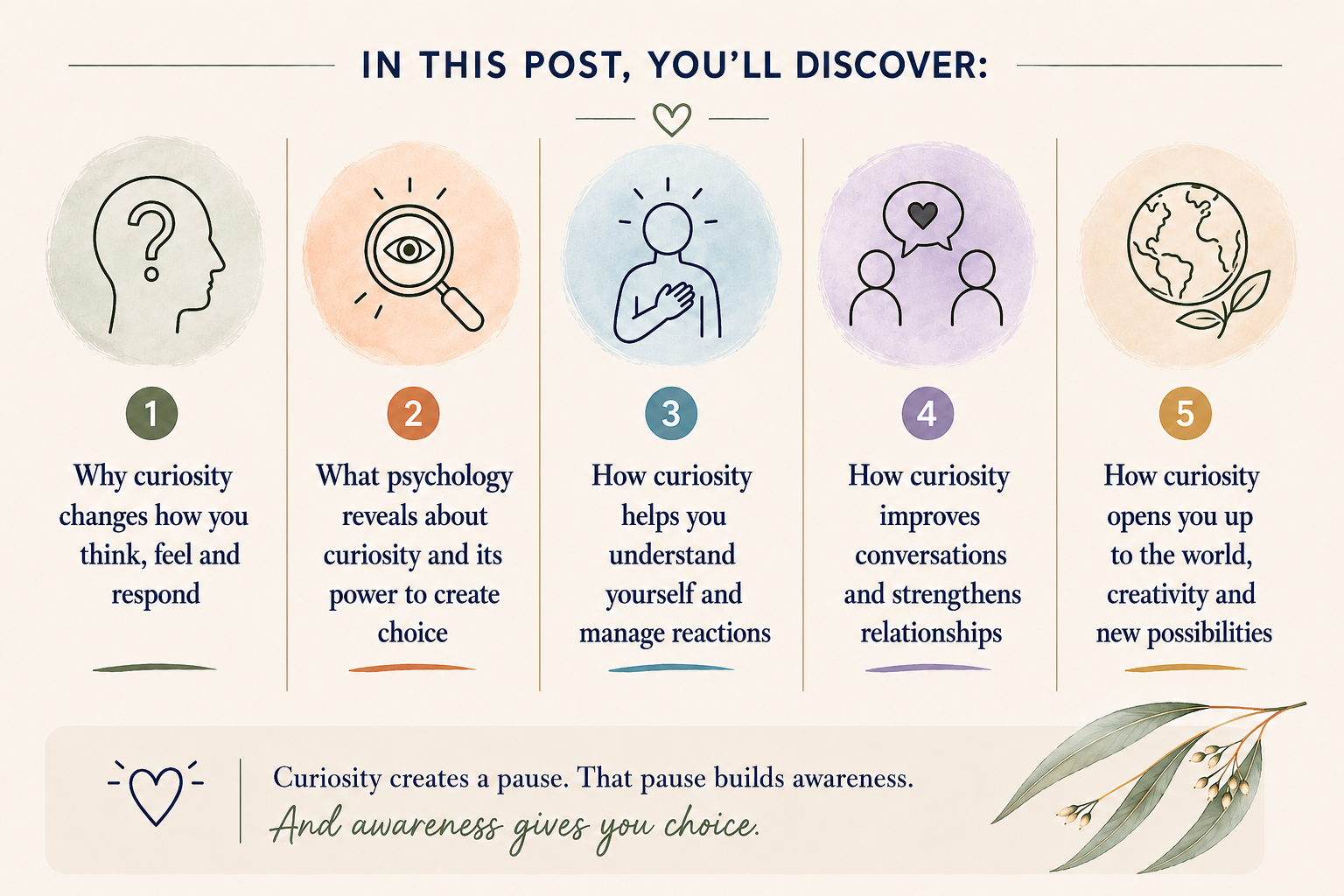
Yet curiosity sits quietly underneath many of the things we are trying to develop in ourselves and our relationships. It changes the way we investigate our own reactions, the way we interpret other people, and the way we respond when something doesn’t make sense. It can even change how we experience places and routines that have become so familiar that we barely see them anymore.
Consider a very ordinary moment. Your partner sends you a message that seems unusually brief. You read it twice and think, They’re annoyed with me. From there, your mind can move remarkably quickly. Perhaps you become anxious, defensive or irritated. Maybe you send a slightly colder reply yourself, or spend the next hour wondering what you’ve done wrong. By the time your partner comes home, a story has developed around a message that originally contained very little information.
There is another possibility, of course. They may be annoyed with you. They may be tired, distracted, worried about something else, rushing between meetings or simply unaware that their message sounded different from usual. You don’t know yet.
That small gap between what happened and what we think it means is where curiosity becomes useful.
Why curiosity matters
Our minds are designed to make sense of things quickly. We notice a pattern, draw a conclusion and move on. Most of the time this is helpful; we could hardly function if we had to consciously analyse every piece of information we encountered. The difficulty comes when an interpretation is experienced as though it were an established fact.
Someone doesn’t return your message and you conclude they are avoiding you. A colleague disagrees with an idea and you decide they don’t respect you. A friend cancels dinner and you start wondering whether the friendship matters to them as much as it matters to you. Your partner becomes quiet and you assume something is wrong between you.
Sometimes the conclusion will be accurate. Curiosity isn’t about becoming so open-minded that you refuse to trust your own perceptions. It is about recognising when you have moved from this is what I know to this is what I think is happening without noticing the difference.
That distinction matters because our interpretations influence our emotions, and our emotions influence what we do next. If you believe someone is deliberately ignoring you, you are likely to behave differently from the way you would if you thought they were simply having a difficult day. The original event may be identical; your experience of it is not.
Curiosity gives us another moment to investigate before the interpretation hardens.
What psychology tells us about curiosity
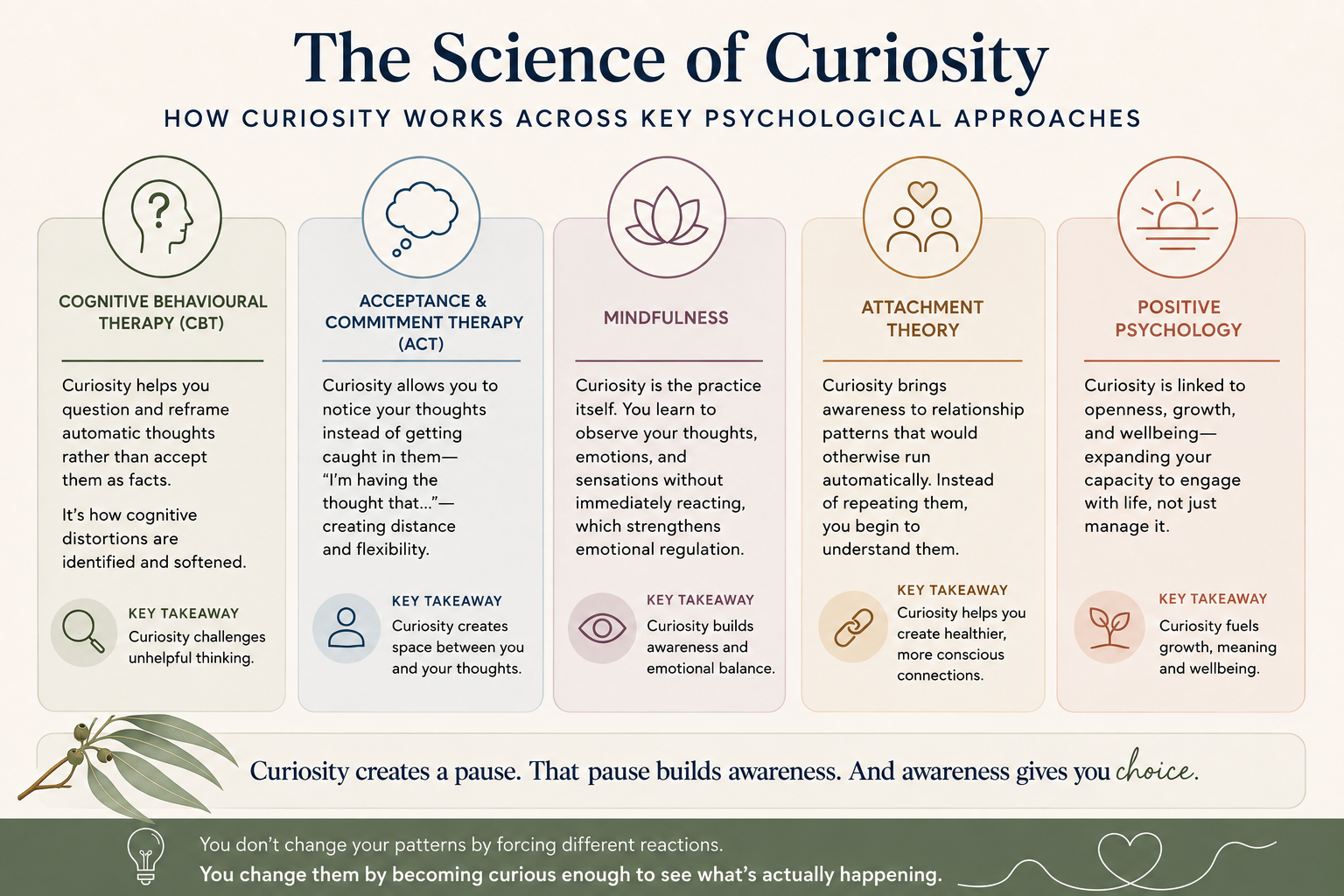
Curiosity isn’t a therapeutic technique belonging to one particular school of psychology. It appears, in different forms, across several approaches because psychological change often begins with becoming interested in what is actually happening rather than immediately trying to control it.
Cognitive Behavioural Therapy, for example, encourages people to examine automatic thoughts and the assumptions attached to them. If the thought is They’re ignoring me, the useful question isn’t necessarily whether you can replace it with something more positive. It may be more useful to ask what evidence you have, what you are assuming, and whether there are other explanations that fit the available information.
Acceptance and Commitment Therapy takes a slightly different approach. One of its useful ideas is learning to notice a thought as a thought: I’m having the thought that I’m not being heard. The wording may sound minor, but it creates a distinction between the person experiencing the thought and the thought itself. You haven’t made it disappear, and you haven’t decided that it is wrong. You have simply stopped treating it as the only possible description of reality.
Mindfulness develops a similar quality of attention by asking us to observe thoughts, emotions and sensations rather than immediately reacting to them. Attachment theory brings curiosity into our relationships, where familiar patterns can be activated remarkably quickly. We may pursue when someone withdraws, become defensive when we feel criticised, or withdraw ourselves when another person’s emotional needs feel overwhelming. These reactions can become so familiar that we stop noticing them as patterns and start thinking of them as simply who we are.
Positive psychology also links curiosity with openness, learning, growth and engagement with life. That is worth remembering because curiosity isn’t only something we need when we are struggling. It can make an ordinary life more interesting by encouraging us to keep discovering things we thought we already knew.
Across these different perspectives, there is a common idea: before we can make a different choice, we usually need to see what is happening. Curiosity helps us do that.
The small space between reaction and response
Viktor Frankl’s writing about the human capacity to find meaning in extraordinarily difficult circumstances has influenced generations of psychologists and readers. His experiences in Nazi concentration camps were, of course, vastly removed from the ordinary situations in which most of us might be trying to practise curiosity, and it is important not to turn such suffering into a convenient motivational metaphor.
There is nevertheless something relevant in his exploration of the relationship between what happens to us and how we respond.
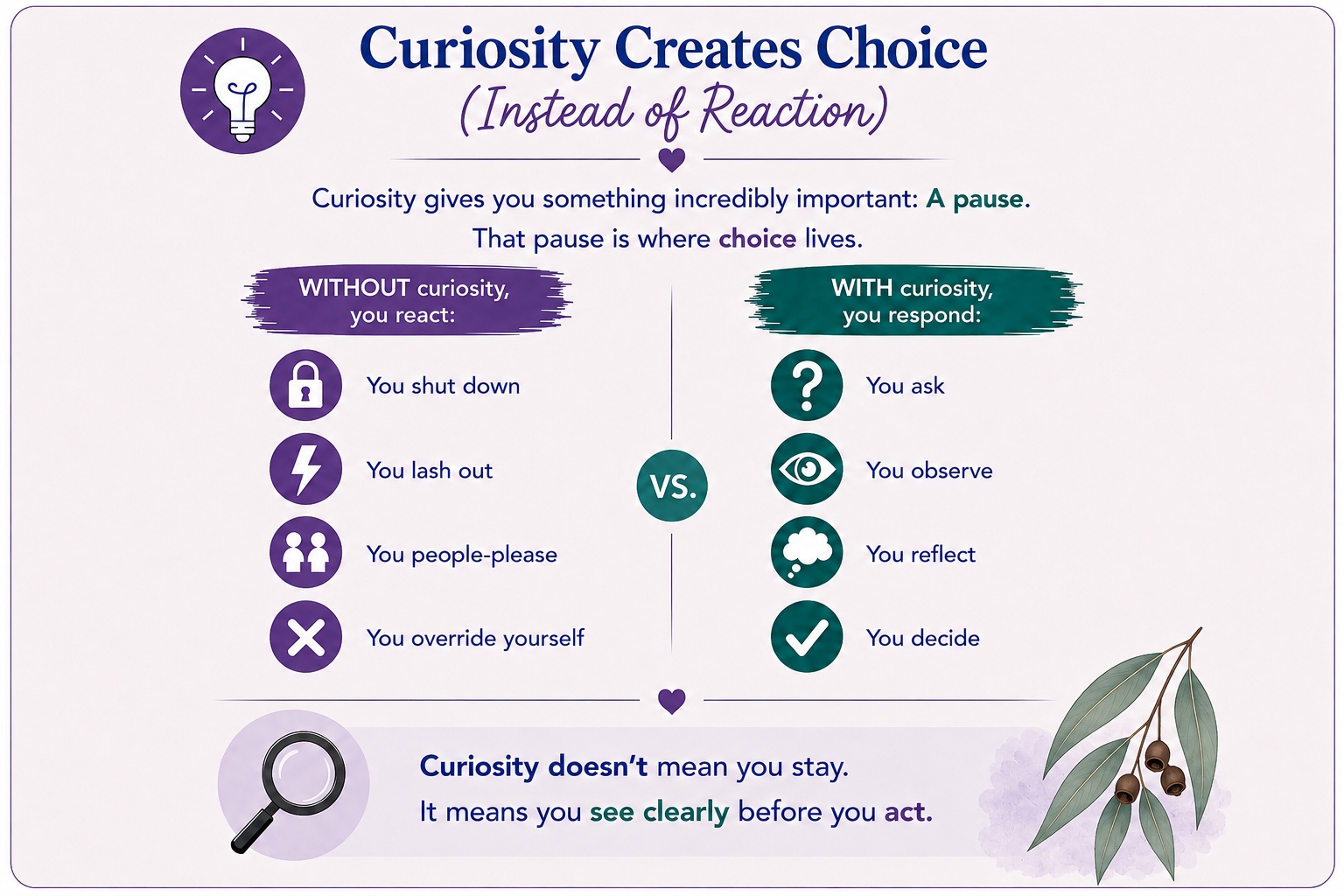
In everyday life, the space between the two can be very small. Someone criticises you and you feel the familiar surge of defensiveness before you’ve fully processed what they said. Your partner goes quiet and you feel anxiety before you have asked what is happening. You receive an email that sounds dismissive and begin constructing an angry response in your head while you are still reading it.
Curiosity can enter somewhere in that sequence. What just happened inside me? You might notice that your shoulders have tightened, that your thoughts are racing or that you are already preparing a defence. None of that means your reaction is wrong. It simply gives you information about the experience you are having.
From there, other questions become possible. What did the person actually say? What did I hear? What did I assume they meant? Does this reaction feel familiar? Is something from an earlier experience being activated here, or is this situation genuinely different?
Sometimes the answer will be uncomfortable. You may discover that someone really has crossed a line. You may also discover that the intensity of your response has something to do with an old wound, an expectation or a fear that belongs partly to another time.
Curiosity doesn’t tell you what conclusion to reach. It helps you gather enough information to reach one more consciously.
Getting curious about yourself isn’t always comfortable
Self-awareness is often presented as though it is inherently pleasant: notice your feelings, understand your patterns and become a better version of yourself. In practice, looking closely at ourselves can be much less flattering.
Carl Jung’s own period of intense introspection, following his professional break with Freud, involved extensive attention to his dreams, emotions, thoughts and inner experiences. His theories remain contested and complex, but the underlying willingness to investigate the parts of ourselves we might otherwise dismiss is interesting.
Imagine receiving feedback at work and finding yourself disproportionately defensive. Perhaps the other person’s criticism was clumsy. Perhaps they were unfair. Perhaps there was something valid in what they said that you didn’t want to hear. It is tempting to settle the matter quickly by deciding which of those explanations is correct.
Curiosity can keep the investigation open.
Why did that particular comment affect me so strongly?
The answer might have very little to do with the person who gave the feedback. Perhaps criticism has always felt like rejection. Perhaps being wrong threatens an idea you have about yourself. Perhaps you have spent years having to defend yourself and your nervous system has become very quick to do it.
Or perhaps the person really was being unfair.
Self-awareness does not require us to turn every reaction into evidence that we are the problem. That would simply replace one form of certainty with another. The useful question is whether we can become interested enough in our own experience to understand what is actually contributing to it.
Sometimes that understanding changes our behaviour. Sometimes it confirms that our original response made sense. Either way, we know more than we did before.
Curiosity changes relationships because it changes conversations
There is a particular moment in relationships when curiosity can be difficult: when you feel accused.
Someone says, “You never listen to me,” and your first instinct is to explain all the times you have listened. Someone tells you that something you said hurt them, and you immediately want to explain what you meant. A partner says they feel neglected, and before you have even understood what they are describing, you’re listing everything you’ve done for them recently.
This is human. Being misunderstood is uncomfortable, particularly when we believe our intentions were good.
Relationship psychologist Harriet Lerner has written extensively about defensiveness, particularly in families and couples. One of the more useful alternatives to immediately defending your intentions is to become interested in the other person’s experience: Help me understand what that felt like for you.
That doesn’t mean agreeing with their interpretation. Your intention still matters, and their perception may not be the whole story. But if you respond only by correcting their account, you may never discover what was actually happening for them.
There is an important distinction here. Curiosity is not the same as compliance.
You can understand why someone behaves badly without excusing it. You can understand why someone is angry without agreeing that their anger is justified. You can listen to someone’s experience and still decide that a boundary is necessary. In some relationships, greater understanding may actually make it clearer that a relationship is unhealthy and that distance is appropriate.
Curiosity is valuable because it gives us a better view of the situation. It does not tell us that every relationship should be saved.
Seeing the world differently
Curiosity also changes our relationship with the world outside our intimate relationships.
Think about somewhere you know extremely well: the street you drive down every morning, your workplace, the local shops, the park where you walk, even the people you see regularly. Familiarity can create the illusion that there is nothing left to discover. We stop looking because we have already decided what we are looking at.
Robyn Davidson’s 1977 journey across the Australian desert offers a much larger example of what happens when attention changes. Travelling through a landscape that many people might describe as empty or inhospitable, Davidson had to observe closely: the terrain, the weather, water, animals and the knowledge of people who understood the country. The landscape didn’t suddenly become different. Her understanding of it became deeper.
There is a smaller version of that experience available to all of us.
Watch your workplace for a week with the intention of noticing its dynamics rather than simply participating in them. Who speaks first in meetings? Who gets interrupted? Whose suggestions are taken seriously? Who becomes quiet when a particular person enters the room? Which assumptions seem to go unquestioned?
None of these observations automatically tells you what they mean. That’s part of the point.
Curiosity allows us to notice before we interpret.
Curiosity and creativity at work
Work can be an especially interesting environment in which to practise curiosity because our professional identities can make uncertainty feel threatening. If we are attached to being competent, discovering that we don���t know something can feel like a criticism rather than an opportunity.
Pixar’s Braintrust meetings, associated with co-founder Ed Catmull, provide an example of a different approach to creative work. Ideas were subjected to challenge and discussion during film development, with the intention of improving the work rather than simply protecting the person who had proposed it.
The useful question in that kind of environment isn’t always, Whose idea is better? It can be, What are we missing?
That question changes the conversation because it moves attention towards discovery. A problem becomes something to investigate rather than something that needs to have an immediate culprit.
The same principle applies to creativity more broadly. Writers, artists, designers and other creative people often work by following questions they cannot yet answer. What isn’t working here? Why does this feel wrong? What would happen if I approached it differently? What am I noticing that I haven’t understood yet?
Curiosity gives creativity somewhere to go because it allows us to remain interested in what we haven’t figured out.
Paying attention to your inner world
Australian writer Tim Winton’s work often explores emotion, identity, belonging and the complexity of human experience. Writing like that requires attention to the inner world: noticing the experiences that stay with us, the feelings we don’t quite understand and the things that seem to matter long after the original event has passed.
We can do something similar without turning ourselves into full-time psychological observers.
Perhaps a conversation that should have been insignificant stays with you all day. You keep replaying something someone said. You insist you’re not bothered, yet you continue thinking about it. There may be something worth noticing.
Why did that matter so much to me?
The answer could be quite straightforward. Perhaps the comment was genuinely hurtful. Perhaps it touched something older. Perhaps you felt excluded, dismissed or powerless. Perhaps it reminded you of a familiar situation in which you didn’t feel heard.
Emotions often have a history. They don’t always arrive as neat explanations, but they usually have some kind of logic to them. When we become curious about that logic, self-awareness becomes more than simply naming an emotion.
It becomes a way of understanding ourselves.
The uncomfortable part: curiosity means tolerating uncertainty
Perhaps the hardest thing about curiosity is that it asks us to tolerate not knowing.
Our minds don’t particularly enjoy uncertainty. If someone doesn’t reply to a message, we want to know why. If a relationship changes, we want an explanation. If somebody behaves differently towards us, we want to know what it means.
So we make one.
The explanation may even be painful, but certainty can feel preferable to ambiguity. They’re losing interest. She’s angry with me. He doesn’t respect me. At least now we know what we’re dealing with.
Except that we may not know.
Curiosity asks us to hold the question open long enough for more information to arrive. This can be particularly difficult when the uncertainty involves something emotionally important.
Singer-songwriter Delta Goodrem has spoken about how being diagnosed with Hodgkin’s lymphoma at eighteen interrupted a life that had been moving rapidly towards a successful career. Experiences like that can force questions about identity, priorities and what matters when the future you expected is suddenly uncertain.
Curiosity doesn’t make an experience like that easier, and it would be simplistic to suggest that asking the right questions somehow transforms suffering into growth. What it can do is create an opportunity to listen to what the experience is showing you rather than immediately trying to get back to who you were before it happened.
We encounter smaller versions of that uncertainty throughout life. A relationship changes. A career doesn’t work out. A friendship ends. We become parents and discover that the person we thought we would be is not quite the person we become. We reach an age where we look back at an earlier version of ourselves and realise how much we didn’t know.
Sometimes curiosity means asking, What is this experience showing me?
Sometimes it means accepting that you don’t know yet.
Staying curious a little longer
Curiosity doesn’t require a complicated practice. In fact, turning it into another performance standard would rather miss the point.
The next time you notice a strong emotional reaction, you might simply become interested in it for a moment. What are you noticing in your body? What thought arrived first? What are you assuming about the other person or the situation? Is there something you know, and something else you have filled in?
One of the most useful questions is often, What else could be true?
It doesn’t ask you to find the nicest possible explanation or talk yourself out of your feelings. It simply prevents the first explanation from automatically becoming the only explanation.
You may still decide that your original interpretation was correct. You may still be angry. You may still need to confront someone, apologise, leave a situation or set a firm boundary. Curiosity doesn’t remove those possibilities. It gives you a better chance of knowing why you’re making the choice.
Over time, that can change something important. You begin to recognise the difference between what is happening and the story your mind has built around it. You start noticing familiar reactions while they are happening rather than only afterwards. You become a little more interested in your own patterns, and a little less compelled to believe every thought simply because it arrived with conviction.
The Relationship Sanity perspective
Curiosity is easy to overlook because it rarely produces a dramatic moment of transformation. More often, it appears in small decisions that nobody else notices: asking one more question instead of assuming, listening for another person’s experience before defending your own, wondering why a particular reaction feels so strong, or admitting that you don’t yet know what something means.
Those moments accumulate.
The original Relationship Sanity framework captures the movement:
From certainty → curiosity From reaction → observation From autopilot → awareness
The point isn’t to become endlessly curious or to question every instinct. Instinct has its place. So does certainty. Sometimes we know enough, and sometimes acting quickly is exactly what is required.
Curiosity simply gives us another option when we suspect we may be filling in the gaps.
It allows us to pause long enough to find out.
Continue your journey
If you want to explore curiosity more deliberately, the Curiosity Workbook is designed to help you examine assumptions, reactions and patterns in everyday life.
You can also explore:
How Curiosity and Boundaries Work Together
When Curiosity Goes Too Far
Because curiosity can deepen understanding, but understanding still needs judgement. Seeing more clearly is only the beginning; what we choose to do with what we see is where Relationship Sanity really begins.