Relationships
Fracture and Repair in Relationships: Healthy Conflict, Kintsugi and Trauma Bonding
No healthy relationship is conflict-free. Even people who love, respect and care deeply about each other will sometimes misunderstand one another, become defensive, disagree about something important or hurt each other without intending to. The more interesting question is what happens afterwards, because a difficult moment can reveal a great deal about the way a relationship actually works.
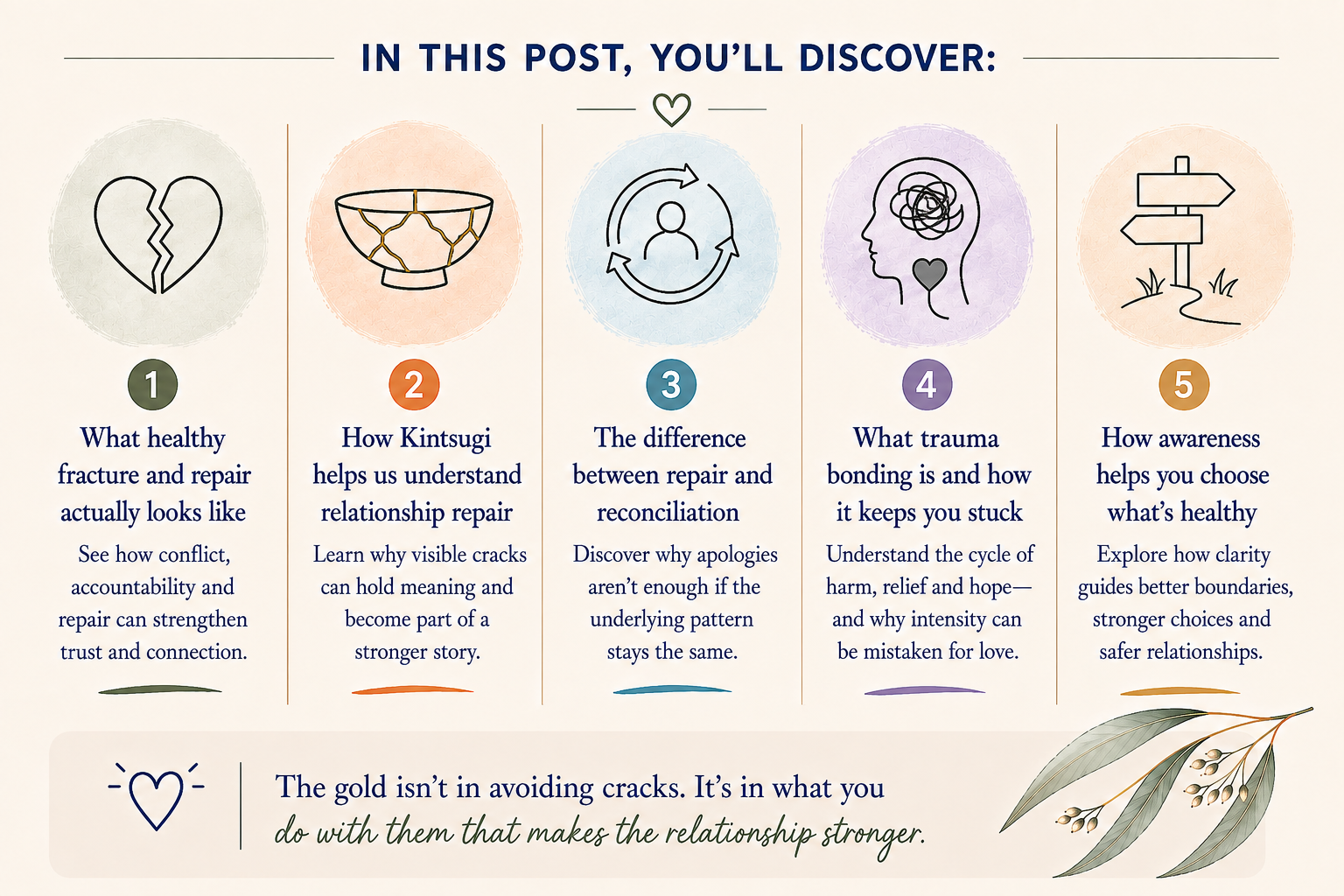
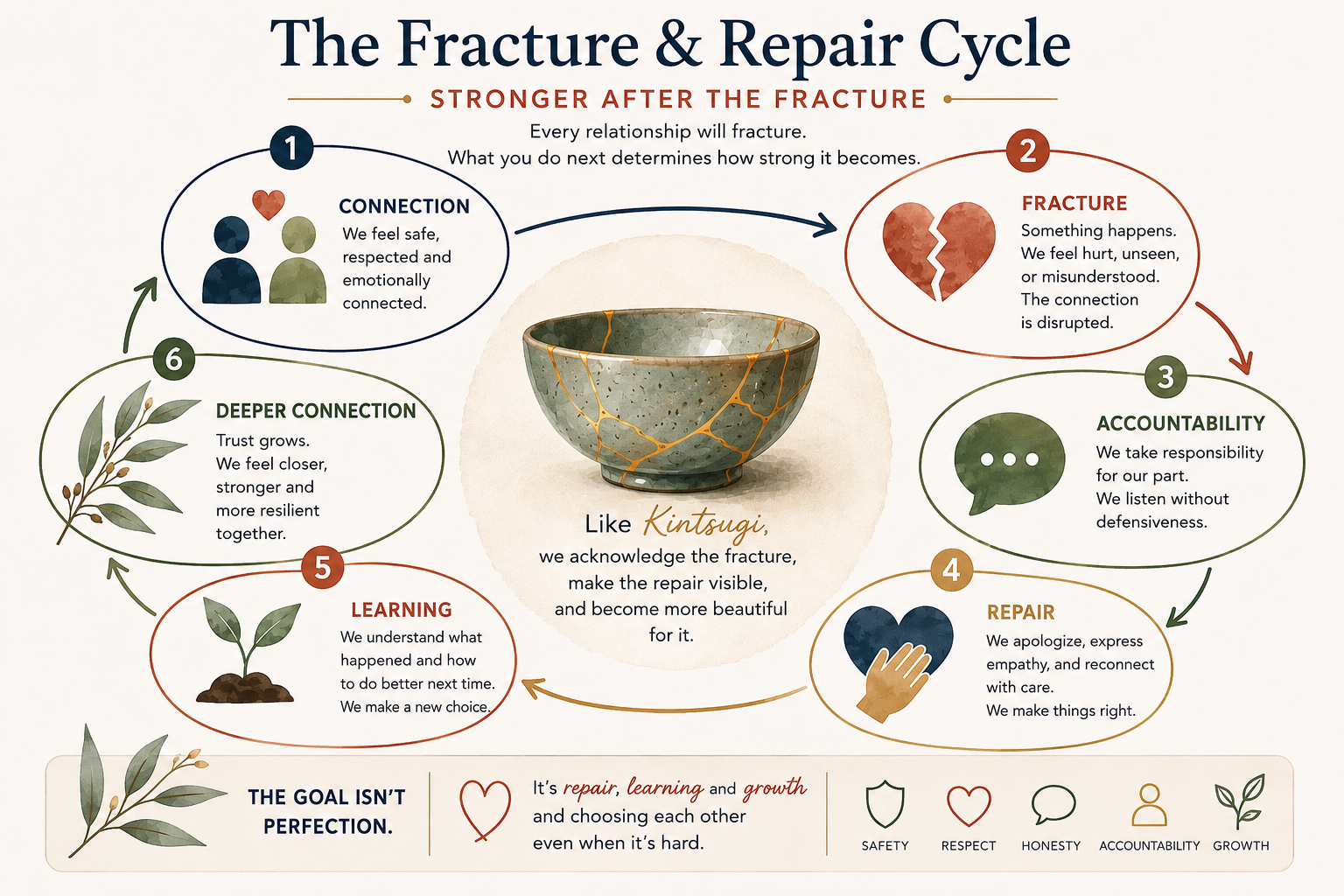
Healthy relationships develop a capacity for what psychologists often describe as rupture and repair. A connection is disrupted, the disruption is acknowledged, each person has an opportunity to take responsibility for their part, and the relationship finds a way forward with some new understanding. Over time, those experiences can build trust and confidence: We can have a difficult moment without the relationship falling apart, and we can find our way back to each other.
The Japanese art of Kintsugi offers a particularly evocative metaphor for this process. Broken ceramics are repaired with lacquer and powdered metal, traditionally including gold, rather than having the cracks disguised as though they never happened. The repaired object carries the evidence of its history, and there is something useful in that idea when we think about relationships: a fracture doesn’t necessarily have to be erased for a relationship to become stronger.
But there is an important distinction that can easily get lost in the metaphor. Repair is not the same thing as reconciliation. Two people can reconnect after a painful experience, feel intensely close again and genuinely love one another without having addressed what caused the fracture in the first place. This is where the difference between healthy conflict and trauma bonding becomes important, because the two can look surprisingly similar from the outside.
What does healthy fracture and repair actually look like?
A relationship fracture can be surprisingly ordinary. One person feels dismissed, somebody becomes defensive, a conversation goes further than either intended, a boundary is crossed, or two people interpret the same situation very differently. None of those things automatically mean the relationship is unhealthy; disconnection is part of being in close relationships with other human beings.
The concept of rupture and repair comes from psychological work around attachment, relationships and psychotherapy, where the ability to repair moments of disconnection is considered an important part of relational health. In a healthy relationship, the fracture becomes something the people involved can examine rather than something that has to be denied or won. One person might say, “I became defensive when you raised that issue, and I can see that made it harder for you to talk to me,” while the other person can acknowledge their own contribution to what happened.
That kind of repair involves more than saying sorry and returning to normal. There is some recognition of what happened, an attempt to understand its impact, accountability for one’s own behaviour and, ideally, some willingness to do something differently next time. The relationship doesn’t have to emerge from every disagreement transformed, but something useful should be possible to carry forward from the experience.
This is one of the reasons successful repair can strengthen a relationship. Each person gradually develops evidence that difficult things can be discussed, that mistakes don’t automatically threaten the entire connection and that accountability doesn’t have to mean humiliation or rejection. The relationship develops a history of having survived difficulty in a constructive way, which can make the next difficult moment feel less threatening.
That doesn’t mean the fracture disappears from the relationship’s history. Sometimes it is precisely the fact that it remains part of the story that makes the repair meaningful.
Kintsugi and the value of the visible crack
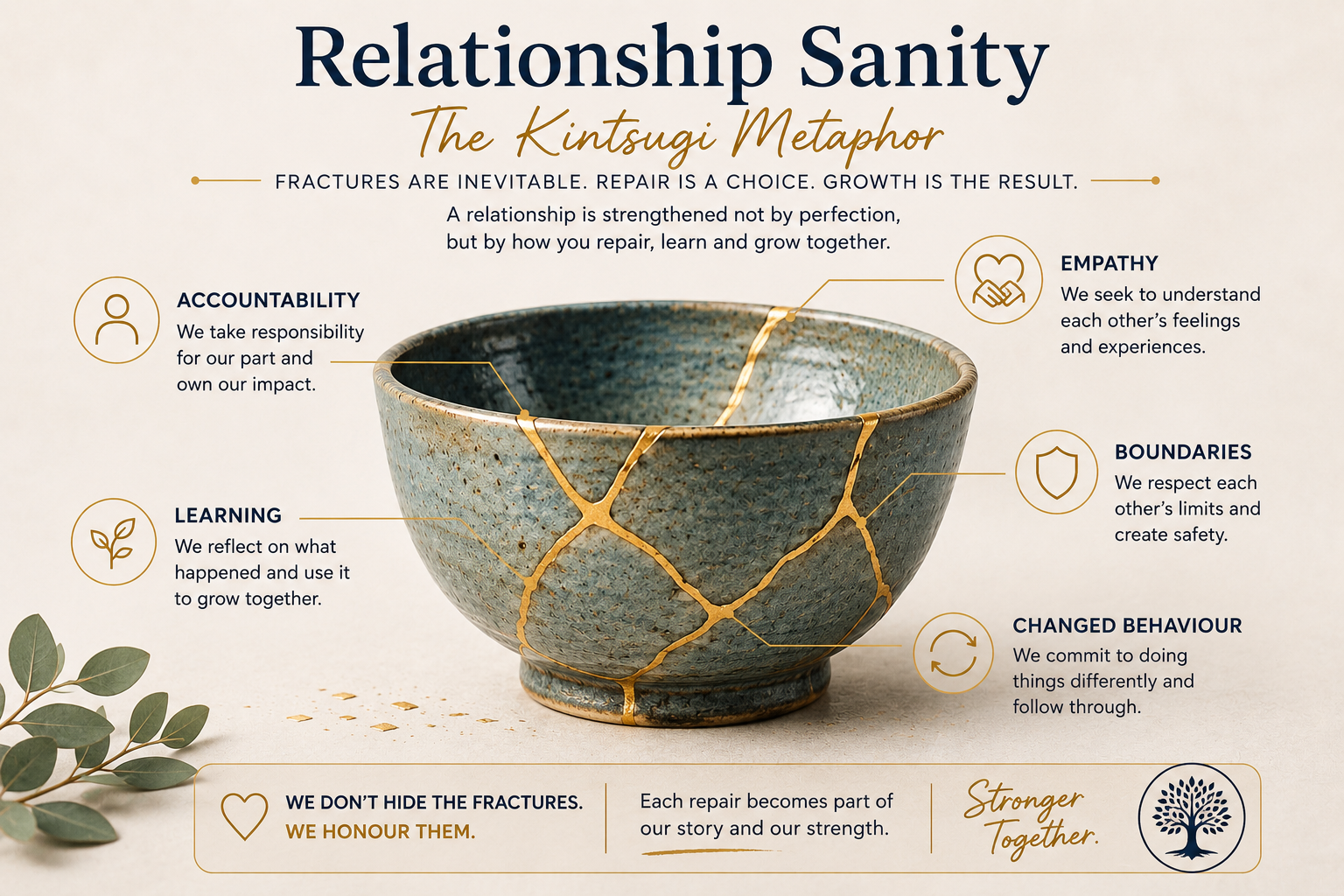
Kintsugi is often described as the Japanese art of repairing broken pottery with gold, although the broader tradition involves lacquer mixed with powdered metals and has a longer and more nuanced history than the simplified metaphor sometimes suggests. What makes the image so compelling for relationship work is the decision not to disguise the places where something has been broken. The repaired object doesn’t have to pretend that it was never damaged in order to have value.
There is a useful parallel here with relationships. Imagine a couple who have a difficult conversation about one person’s tendency to become defensive whenever the other raises a concern. They don’t simply apologise, hug and agree to forget about it; they begin to understand what happens when the pattern is activated, one person learns to raise concerns differently, the other becomes better at listening before defending themselves, and both become more aware of the point at which the conversation starts going off course.
The next difficult conversation may still be difficult. Neither person has suddenly become perfectly emotionally regulated, and the old reaction may still appear from time to time. What has changed is that they now have information they didn’t have before, including some knowledge of how to recognise the pattern and what helps them return to a more constructive conversation.
That is where the Kintsugi metaphor becomes useful. The gold isn’t the damage itself, and the point isn’t that being hurt somehow makes a relationship better. The value is in what was done with the fracture: the accountability, the difficult conversation, the empathy, the boundary, the changed behaviour and the willingness to learn from what happened.
Over time, those experiences can become part of the relationship’s strength. The couple may eventually know something important that they could only have learned by going through difficulty together: This is what happens to us when we feel criticised, and this is how we can handle it differently.
But not every crack should be repaired
This is where the metaphor needs some care. Kintsugi is a useful image for meaningful repair, but it should never become an argument for staying in a relationship that repeatedly causes harm simply because the relationship can still be put back together. There is a difference between developing resilience through ordinary relational difficulty and becoming increasingly skilled at surviving behaviour that should not be happening in the first place.
If the same harmful behaviour continues, apologies are followed by the same behaviour, boundaries are repeatedly violated, accountability is avoided, or one person is afraid of the other, something more serious may be happening. The fact that the couple keeps reconnecting does not, by itself, tell us that repair is taking place. Sometimes what looks like repair is simply reconciliation after another rupture.
That distinction matters because reconciliation can feel very good. After a painful argument, emotional distance or threat of separation, the return to affection can bring enormous relief, particularly when the relationship has felt uncertain or frightening. The relief is real, but relief alone isn’t evidence that the underlying problem has been resolved.
Trauma bonding is a different kind of cycle
Trauma bonding isn’t simply having a lot of conflict. It refers to a powerful emotional attachment that can develop within patterns involving harm, abuse, manipulation, fear, control or emotional instability, particularly when periods of mistreatment are followed by affection, reassurance, relief or renewed connection.
The cycle can be difficult to recognise because the relationship may contain genuine love and genuinely good experiences alongside the harmful ones. Someone may be frightened by their partner during one period and deeply comforted by that same person later; they may feel rejected, then intensely wanted; they may be considering leaving one week and convinced that everything is finally going to be different the next.
That contrast can be psychologically powerful. When distress is followed unpredictably by affection or relief, the relief itself can become highly reinforcing, and the person may become increasingly attentive to signs that the good period is returning. The relationship can begin to feel particularly intense after a rupture, which can make the reconnection seem like proof of how deeply the two people love each other.
Sometimes intensity is mistaken for intimacy.
That doesn’t mean the affection is necessarily fake. One of the difficult things about trauma bonding is that the good moments can be genuine and still exist within a harmful pattern. A person can love someone who is hurting them, feel profoundly connected to them and still be caught in a cycle that is damaging their ability to trust their own judgement.
Reconciliation isn’t the same as repair
This may be the most important distinction in the entire discussion. Two people can argue, separate, apologise, have passionate sex, exchange declarations of love and feel intensely connected again without actually having repaired what caused the rupture. They have restored contact, perhaps even restored affection, but the underlying pattern may remain untouched.
Healthy repair generally involves some recognition of what happened and its impact, along with accountability, empathy and a willingness to change behaviour. Boundaries can be respected rather than negotiated away, difficult conversations can remain possible, and the person who was hurt doesn’t have to pretend they weren’t hurt in order to restore the relationship. Most importantly, something about the way the two people handle the problem can become different over time.
An unhealthy cycle may look quite different. There might be denial, minimisation or blame, followed by promises that aren’t reflected in subsequent behaviour; affection may arrive primarily to end the conflict, and pressure to “move on” may replace any genuine attempt to understand what happened. The same behaviour then appears again, perhaps with increasing anxiety about when the next rupture will occur.
So rather than asking only, Did they apologise?, it can be more revealing to ask what happened because they apologised. Did anything change afterwards? Did the person become more accountable, more respectful of the boundary and more capable of handling the same situation differently, or did the apology simply restore enough closeness for the cycle to begin again?
Healthy conflict should teach you something
Healthy relationships aren’t perfect relationships. They are relationships in which people can learn from what happens between them, including the moments when they get it wrong.
After a difficult conversation, you might discover that one person needs a little time before they can talk productively, while the other needs reassurance that the conversation isn’t a threat to the relationship. You might realise that a particular subject reliably activates defensiveness, or that one person’s attempt to explain themselves is experienced by the other as dismissal. None of these discoveries guarantees that the next conflict will go smoothly, but they give the relationship more information to work with.
The next time the same tension appears, the couple isn’t necessarily starting from the beginning. They may recognise the early signs, understand what tends to happen next and have a better idea of what helps them reconnect. The original fracture has become part of their relational knowledge.
That is the “gold” in the Kintsugi metaphor. It isn’t the fact that the relationship was damaged; it is the knowledge created through taking the damage seriously and doing something constructive with it.
With trauma bonding, the learning can look very different. The cycle may become increasingly familiar: harm, distress, reconciliation, relief, renewed attachment and then another episode of harm. The reconciliation can feel powerful precisely because the distress was so intense, but if the underlying behaviour remains unchanged, the relationship hasn’t necessarily become safer.
It may simply have become better at resetting itself.
The danger of confusing relief with safety
This is one of the subtler aspects of these cycles. When someone has been distressed for a period of time, the return of affection can produce a powerful sense of safety, even if the conditions that created the distress remain unresolved. The emotional contrast between the two states can make the reconnection feel unusually meaningful.
That is very different from the quieter kind of safety that develops in a relationship where people know they can disagree without being punished, where boundaries are taken seriously and where mistakes can be acknowledged without the entire relationship becoming unstable. Healthy safety doesn’t usually require a crisis before you can feel its presence.
This distinction can be difficult to see from inside a relationship because intense reconciliation may genuinely feel like connection. You may experience an enormous sense of closeness after believing you were about to lose the person, and that experience can be interpreted as evidence that the relationship is stronger than the conflict.
But a relationship becoming more emotionally intense after repeated pain isn’t necessarily becoming more secure.
Sometimes it is becoming more dependent on the relief that follows the pain.
A better question to ask
When you’re trying to understand the health of a relationship, “Do we love each other?” is worth asking, but it doesn’t tell you very much on its own. A more revealing question may be, What happens to us when things go wrong?
Can you talk about what happened without fear of retaliation or punishment? Can each person acknowledge their contribution without the conversation becoming a competition over who is more at fault? Can a boundary be expressed and respected without one person having to threaten, plead or repeatedly defend it? When someone apologises, does their behaviour eventually reflect what they said?
These questions aren’t intended as a checklist for deciding whether a relationship is good or bad. Relationships are too complicated for that, and there will be circumstances in which a couple genuinely wants to change a pattern but struggles to do so consistently. What matters is the direction of the relationship over time: are the people within it becoming more capable of understanding each other and creating safety, or are they becoming more practised at surviving the same damage?
That last distinction is worth sitting with. If every rupture ends in a dramatic reconciliation but the same behaviour keeps returning, the intensity of the reunion may tell you very little about the health of the relationship. If each difficult experience leads, slowly and imperfectly, to greater accountability, better boundaries, more understanding and different behaviour, then the relationship is accumulating something valuable.
The crack is becoming part of what the two people know about how to care for the relationship.
Not every relationship should be put back together
There is another part of the Kintsugi metaphor that deserves to be said plainly: not every broken object needs to be repaired, and not every relationship should be preserved. If someone repeatedly hurts you, violates your boundaries, refuses accountability, intimidates you or uses reconciliation to maintain your attachment without changing their behaviour, becoming better at repairing the relationship may not be the answer.
Sometimes the healthiest response to repeated damage is to stop participating in the cycle. That can be particularly important when abuse, coercive control or fear are involved, because the language of mutual repair can become misleading when the two people do not have equal power or responsibility for what is happening.
Healthy repair requires genuine participation from both people. One person cannot create relational safety on behalf of someone who continues to make the relationship unsafe.
That is why the distinction between healthy fracture and repair and trauma bonding matters so much. In one, difficulty becomes an opportunity for accountability and learning; in the other, the relief that follows harm can become part of what keeps the attachment going.
What does the crack tell you?
Perhaps the most useful thing about the Kintsugi metaphor isn’t the image of gold at all. It is the idea that what happens after a fracture tells us something about the relationship itself.
A difficult conversation can teach two people how to communicate more effectively. A boundary can reveal whether the other person is capable of respecting it. An apology can show whether someone is willing to take responsibility, and changed behaviour can tell you whether that responsibility was more than words. A painful misunderstanding can sometimes create greater empathy, while another may reveal a fundamental incompatibility that needs to be taken seriously.
The relationship carries those experiences forward. Over time, you can begin to see whether the repairs are actually changing the shape of the relationship or whether they are simply allowing the same pattern to continue.
That is why the question isn’t whether your relationship has cracks. Every close relationship will have them.
The more important question is what happens when one appears.
Does someone become curious about what happened, or immediately defensive? Is there accountability, or does responsibility keep moving somewhere else? Do boundaries become clearer and more respected, or increasingly difficult to maintain? Does the relationship become safer after the repair, or does everyone simply feel relieved that the conflict is over?
Those answers may tell you far more about the health of a relationship than how rarely you argue.
The Relationship Sanity perspective
Relationships are going to fracture because people are going to misunderstand each other, become defensive, get tired, become frightened and occasionally behave badly. Expecting a relationship without conflict sets an impossible standard, and it can make ordinary disagreement seem more alarming than it needs to be. The more useful standard is whether the people involved have developed a capacity to recognise disconnection, take responsibility and repair what can genuinely be repaired.
Kintsugi gives us a beautiful way of thinking about that process because the repaired crack isn’t hidden. It becomes part of the object’s history, evidence that something happened and that someone cared enough to restore it. In relationships, the equivalent isn’t simply surviving another argument; it is what becomes different because the argument happened.
At the same time, the metaphor has limits. We shouldn’t romanticise damage, and we shouldn’t confuse repeated reconciliation with healthy repair simply because the relationship feels intensely connected again afterwards. Some relationships need better repair; others need stronger boundaries; and some need to end.
Perhaps the question worth carrying forward is therefore quite simple: What happens to us when things go wrong?
A healthy relationship won’t necessarily have fewer cracks than everyone else’s. Over time, though, the cracks should tell a story of increasing understanding, accountability, safety and care rather than a story of repeated damage followed by temporary relief.
The strength of a relationship isn’t measured by whether it has ever cracked. It is revealed by what happens afterwards, and by whether the repair helps the people within it become more secure, more honest and more able to remain connected without losing themselves.