Personal growth
Growing Is a Lifelong Journey
We often talk about growing as though it is something we eventually finish. We grow up, become adults, get an education, build a career, form relationships, perhaps become parents, and somewhere along the way we can begin to believe that we have finally figured life out. Then life has a way of showing us that we haven’t. It rarely does this all at once. More often, it happens quietly, through an experience that doesn’t fit the person we thought we were, or a situation that makes an old belief suddenly feel inadequate.
Think about teenagers. There is a particular stage of adolescence when many young people become convinced they know everything. They have enough experience to form strong opinions, enough independence to challenge the adults around them, and just enough knowledge to mistake understanding one part of the world for understanding the whole thing. Most of us smile when we remember that stage because, with the benefit of age, we can see the gaps in their understanding. What is less comfortable is recognising that we haven’t necessarily outgrown the tendency; we have simply become better at making certainty sound sophisticated.
We reach our twenties and think we understand ourselves, then reach our thirties and look back at our twenties with a mixture of affection and disbelief. We become parents and discover that knowing how we intended to parent is very different from discovering how we actually respond when we are exhausted, frightened or overwhelmed. We experience relationships that change us, losses that alter our priorities, successes that reveal unexpected insecurities and mistakes that teach us things we could not have learned any other way. The perspective we gain later can make our earlier decisions look obvious in retrospect, but hindsight has a habit of concealing how little information we actually had at the time.
That is the strange gift of hindsight: it gives us better vision after the moment has passed. It can show us what we couldn’t see then, but it can also tempt us into judging the person we were for not knowing what we know now. Perhaps a kinder and more accurate interpretation is that the person we were had a different set of experiences, assumptions and emotional resources. We are able to see differently because something happened between then and now. That is growth.
We Are Supposed to Change
There is something slightly uncomfortable about the idea that changing our minds can be a sign of growth because many of us have been taught, explicitly or otherwise, to value consistency. We like knowing who we are. We like being able to say, “I’ve always believed that,” or “I’m just not that kind of person.” A stable sense of identity can be useful, but there is a difference between having a sense of who you are and deciding that you have already understood yourself completely.
The person you were at twenty could not possibly know everything the person you are now knows. They hadn’t lived enough life yet. There are things you don’t understand because you haven’t encountered them, things you haven’t learned because circumstances haven’t required you to learn them, and beliefs you currently hold that may change when you are exposed to information or experiences you don’t have today. That isn’t evidence that you are failing at adulthood. It is one of the ordinary consequences of being a human being who continues to experience the world.
Nature itself is full of growth, adaptation and change. Bodies change. Environments change. Living things respond to what is happening around them. Human beings do the same thing, although we can become surprisingly attached to the idea that changing ourselves means something has gone wrong. Sometimes change does mean that something needs attention. Often it simply means that life has given us information our previous version of ourselves didn’t have.
This is why statements such as “That’s just who I am” are worth examining occasionally. Sometimes they describe something fundamental about us, such as a value or temperament. Other times they can become a convenient way of closing the conversation before we have discovered whether change is possible. Growing means remaining open to the possibility that something about you may be different from what you once believed, even when the discovery is inconvenient.
The World Doesn’t Stand Still
There is another reason lifelong growth has become increasingly important: the world itself keeps changing. The world many of us grew up in may bear very little resemblance to the world we are navigating now, particularly when it comes to technology, communication, work and the way information reaches us. Before the internet, information moved differently. Communication moved differently. Relationships moved differently. Even the pace at which we were expected to respond to other people was different.
Today, we can encounter an extraordinary amount of information before breakfast. We navigate changing technology, shifting social expectations, new forms of communication, changing workplaces and an increasingly complicated social environment. We can be expected to make important decisions while still trying to work out what is actually happening. Sometimes there simply isn’t enough time to gather all the information we would ideally like to have, so we make the best decision we can with what is available and then adjust when we learn more.
That makes self-awareness more important, not less. When the world around us changes, some of our old assumptions may stop fitting the circumstances in front of us. A belief about relationships that made sense in the environment in which we grew up may not necessarily make sense in our own relationships. A way of communicating that worked at one stage of our life may create difficulties at another. Even our understanding of ourselves can become outdated if we continue interpreting our behaviour through an old story.
It is worth occasionally asking whether what we believe still makes sense in the life we are actually living. Is this still true? Am I responding to what is happening now, or am I responding to something that happened then? What information might I be missing? We don’t have to turn these questions into a constant process of self-analysis. Sometimes simply being willing to ask them is enough to prevent certainty from hardening into rigidity.
And perhaps the most useful question of all is the simplest: What don’t I know yet? There is humility in that question, but there is also freedom. It leaves room for the possibility that the next experience, conversation or piece of information might teach us something we could not have learned by thinking harder about what we already know.
Relationships Require Two People Who Keep Growing
This becomes particularly important in relationships. We sometimes imagine a successful long-term relationship as finding the right person and then staying essentially the same people together for the rest of our lives. But that isn’t what actually happens. You don’t grow old with exactly the person you met and fell in love with; you grow old alongside someone who is continually being shaped by experiences, circumstances and choices, while you are being changed by yours.
The person you fell in love with at twenty-five may have different priorities at thirty-five, different fears at fifty and different ideas about what matters at seventy. Their confidence may change. Their interests may change. Their health may change. Their ambitions may change. They may become more comfortable with themselves, or discover parts of themselves they had previously ignored. Sometimes their values or dreams change too. The same thing is happening to you, whether you notice it or not.
This means that the challenge in a long-term relationship isn’t simply continuing to love the person you first met. It is learning to know the person they are becoming while allowing them the freedom to know the person you are becoming. That requires curiosity, but it also requires tolerance for uncertainty because neither person can know in advance exactly who the other will be in ten or twenty years.
Sometimes those changes bring people closer. Sometimes they expose differences that weren’t obvious earlier in the relationship. A person who once wanted the same lifestyle may change their mind. Someone who spent years putting everyone else first may eventually decide they need something different. One partner may become more ambitious while the other becomes less interested in career. These changes don’t automatically mean that the relationship is failing, but they do mean that love alone cannot prevent people from changing.
A healthy long-term relationship therefore isn’t necessarily one in which neither person changes. It is one in which there is enough safety for both people to change without having to hide who they are becoming, while still being honest about what those changes mean for the relationship.
You Have to Keep Meeting Your Partner
There is something beautiful about realising that you may have to keep meeting the person you love. Not because you don’t know them, but because you know them well enough to notice when they are changing. Familiarity can make relationships feel secure, but it can also encourage us to stop paying attention. We begin responding to what we believe someone is like rather than to what they are actually showing us.
It happens in small, ordinary moments. Your partner walks through the door looking distant and you immediately decide they are angry with you. A friend cancels plans and you assume you know what it means about the friendship. Someone who has always been confident becomes quieter, but because you have a fixed picture of them, you interpret the change as temporary or out of character rather than wondering whether something important has happened. We can be so familiar with the people we love that we stop being curious about them.
We do this to ourselves as well. We can become attached to an old idea of who we are and then use it to interpret everything that happens afterwards. “I’m not that kind of person.” “I would never do that.” “This is just who I am.” Those statements can sometimes reflect genuine values or enduring characteristics, but they can also become identity statements that prevent us from investigating what is actually happening.
Self-knowledge isn’t about creating a permanent definition of yourself. It is about developing an ongoing relationship with yourself, one in which you remain willing to notice when something has changed. That can be more challenging than it sounds because sometimes the new information is welcome and sometimes it isn’t. Occasionally, the person we discover ourselves to be is not quite the person we wanted to find.
Knowing Yourself Is a Lifelong Journey
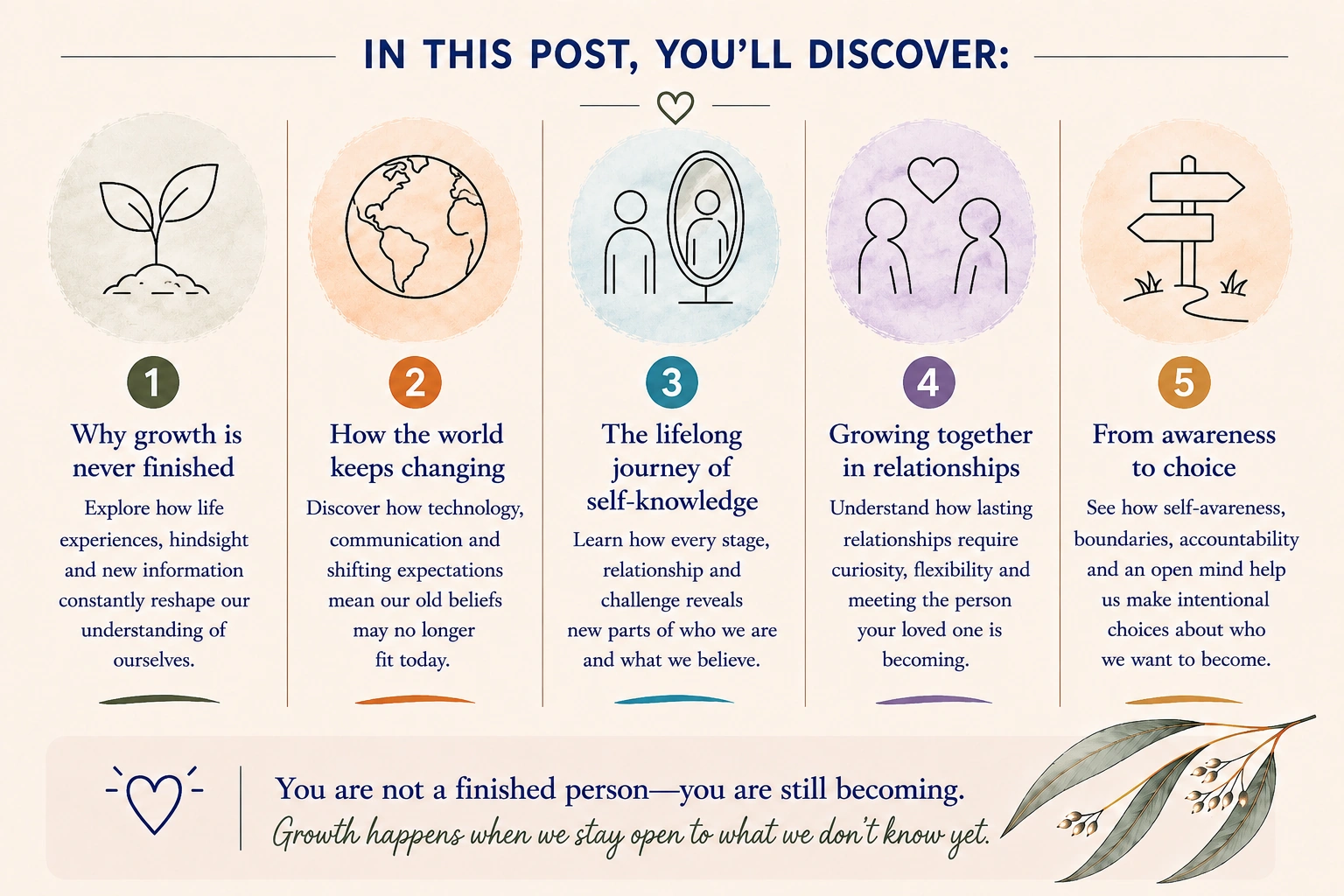
This is why knowing yourself can never really be a completed project. You are not a fixed object waiting to be completely understood; you are a person having experiences, and experiences can change the way you understand yourself. Sometimes the change is gradual enough that you hardly notice it. Other times one experience can make you look back at years of your life through a completely different lens.
Every stage can reveal something new. Your twenties may teach you about independence, while your thirties may expose your relationship with responsibility. Parenthood can reveal parts of yourself you didn’t know existed. Loss can alter what you value. Success can expose how closely your sense of worth is tied to achievement. Failure can show you what happens when shame takes over. Love can reveal your attachment patterns, while conflict can tell you something about your boundaries.
None of these experiences automatically makes us wiser. We still have to pay attention to what they are telling us. A difficult relationship, for example, might teach someone that they need stronger boundaries, but it might also leave them believing that nobody can be trusted. The experience itself doesn’t determine the lesson. There is interpretation involved, and sometimes the lesson we take from an experience needs to be revisited later.
This is why self-awareness is something we maintain rather than something we achieve. We keep noticing what has changed, questioning assumptions that no longer fit, recognising our blind spots and becoming curious about reactions that seem stronger than the situation itself would explain. We may discover that a coping strategy that once helped us is now getting in the way, or that something we thought was a personality trait was actually a response to circumstances we no longer live in.
Think of it less like completing a course and more like maintaining a relationship with yourself. You keep getting to know the person you are.
Growth Doesn’t Mean Constant Self-Improvement
There is an important distinction here because the language of personal growth can easily become exhausting. We live in a culture that can turn almost anything into a project: improve your communication, optimise your habits, regulate your emotions, become more confident, heal your wounds, increase your productivity and keep working on yourself. Some of those things can be genuinely useful. The problem begins when self-improvement quietly becomes another way of telling ourselves that we are not acceptable as we are.
Lifelong growth does not require constant analysis or an endless search for the next thing that needs fixing. If every moment of self-reflection ends with another deficiency to work on, we can end up relating to ourselves as though we are a permanent renovation project. There is a point at which personal development starts to resemble self-rejection with better vocabulary.
There is another way to approach it. Instead of assuming, “I need to become a better person because who I am isn’t enough,” we can sometimes become interested in what we don’t yet understand. “I wonder why I respond this way.” “I wonder what this experience is showing me.” “I wonder whether this belief still fits.” Those questions don’t require us to condemn the current version of ourselves before we are allowed to grow.
Sometimes growth means changing something. Sometimes it means understanding something and deciding that it is worth keeping. Sometimes it means accepting a limitation rather than spending years pretending it isn’t there. Growth isn’t necessarily about becoming someone else. It can be about becoming more familiar with who you are, how you came to be that way, and whether the person you are becoming is aligned with the life you actually want to live.
Keep Your Mind Open to Being Wrong
One of the hardest parts of growing is accepting that some of the things we believe today may eventually turn out to be incomplete or wrong. This is particularly difficult when our beliefs have become intertwined with our identity. Changing our mind can feel less like updating information and more like admitting that the person who held the old belief was foolish.
That can make people remarkably defensive. We may continue arguing for a position we no longer feel entirely certain about because admitting that we have changed our minds feels like losing. We may avoid information that challenges us, not because we don’t care about truth, but because the psychological cost of reconsidering ourselves feels too high.
Yet changing your mind isn’t necessarily weakness. Sometimes it is evidence that you have learned something.
There is considerable maturity in being able to say, “I didn’t know then what I know now.” There is also maturity in saying, “I see that differently now,” or “I was wrong.” And sometimes the most honest answer is simply, “I don’t know.” We don’t have to have an immediate opinion about everything, and we don’t need to defend every belief merely because we once held it.
Being willing to update yourself doesn’t mean abandoning your values. It means allowing your understanding to remain responsive to reality. You can hold strong principles and still recognise that your interpretation of a particular situation was incomplete.
The Person You Are Becoming Matters
Growing older doesn’t automatically make us wiser. Age gives us experience, but what we do with that experience is where much of the growth happens. Two people can live through similar circumstances and emerge with very different understandings of what happened, partly because experience is always interpreted through the person experiencing it.
We can become more rigid or more flexible. We can become more defensive about what we already believe, or more willing to investigate what we don’t understand. We can use difficult experiences to build walls around ourselves, or we can allow those experiences to deepen our understanding of ourselves and other people. None of this happens automatically just because another birthday has passed.
Someone who has been hurt may become more discerning, but they may also become suspicious of everyone. Someone who has been betrayed may develop stronger boundaries, or they may decide that trusting anybody is foolish. Someone who has experienced failure may become more resilient, or they may organise their life around never risking failure again. The experience itself doesn’t determine the lesson. What we make of it matters.
That is why lifelong growth involves more than accumulating experiences. It involves being willing to examine what those experiences have taught us, including the possibility that some of the conclusions we drew at the time may need revisiting.
When Growth Changes a Relationship
Personal growth can have consequences for the people around us, particularly when a relationship has become comfortable with an older version of who we are. If you become more comfortable expressing your needs, someone who was accustomed to you staying quiet may not welcome the change. If you stop accepting behaviour you previously tolerated, another person may accuse you of becoming selfish or difficult. If you become less reactive, someone who was used to getting a particular response from you may not know how to relate to the new version of you.
That doesn’t automatically mean that every change we make is healthy. Other people can sometimes see things in us that we cannot see ourselves, and useful feedback remains useful even when we don’t enjoy hearing it. Growth isn’t a licence to assume that every change is improvement simply because it feels liberating.
But there are also relationships in which the version of you that was easiest to love was the version who asked for less, challenged less or needed less. When that person begins to change, the relationship has to adjust. Sometimes it does. Sometimes the relationship reveals itself to have depended on the very patterns you are trying to leave behind.
This is one reason growth can be unsettling. We often imagine that becoming healthier will automatically make our relationships healthier too. Sometimes it does. Sometimes it exposes an incompatibility that was easier to ignore before. Growing as a person does not guarantee that every relationship will grow with you.
We Have to Keep Growing Alongside the People We Love
It isn’t only our partners who change. Children grow into people whose opinions may surprise us. Parents age and gradually become people who need things from us that they didn’t need before. Friends develop new interests, beliefs and priorities. Someone we have known for decades can become unfamiliar in ways that are difficult to put into words.
Sometimes we resist these changes because we miss who the person used to be. There is grief in that, particularly in long relationships. We can love the person standing in front of us and still miss an earlier version of them. Both things can be true.
The same thing happens within ourselves. There are versions of us that no longer exist, and sometimes we miss those people too. We may remember being more carefree, more ambitious, more hopeful or less burdened. A photograph can bring that person vividly to mind, but it cannot return us to the circumstances in which that version of us existed.
Long relationships therefore contain a quiet element of letting go. We have to release our expectations of who someone was supposed to remain while deciding whether we still want to know the person they have become. That isn’t a failure of love. It is one of the realities of loving people who are alive.
What Does Growth Actually Look Like?
Lifelong growth doesn’t necessarily arrive as a dramatic transformation. Often it is much less visible than that. It might be noticing that you handled an argument differently this year than you would have five years ago, or realising that you can hear criticism without immediately experiencing it as a judgement on your character.
It might be listening to your adult child without rushing to give advice because you have finally recognised that being useful isn’t always the same as being helpful. It might be taking an interest in something your partner cares about because you genuinely want to understand why it matters to them. It might be changing your mind after hearing information that challenges something you have believed for years, even though changing your mind initially feels uncomfortable.
It might also mean deciding not to change something. That matters because lifelong growth isn’t a requirement to become increasingly different from the person you were. Sometimes reflection confirms that an old value was worth keeping. Sometimes experience strengthens a belief rather than dismantling it. The difference is that you have examined it rather than simply inherited it or defended it because it has always been yours.
There may be no dramatic moment when you suddenly become a wiser person. More often, growth shows up in the way you respond to an ordinary Tuesday. You notice something you would once have missed. You pause before reacting. You understand someone differently. You recognise an old pattern and decide, consciously, whether you want to repeat it.
Wherever You Are in Your Journey
Maybe you are just beginning to understand yourself. Maybe you’re looking back at decisions you made years ago and seeing them differently. Perhaps you’re questioning patterns you’ve carried for decades, or noticing that a relationship has changed because you have changed.
Or perhaps nothing dramatic has happened at all. Maybe you’ve simply realised that it has been a long time since you stopped and asked yourself who you are now. That question can be surprisingly revealing because the answer may be different from the one you would have given five or ten years ago, even if your circumstances appear largely unchanged.
There is no particular age at which self-awareness becomes irrelevant. You can begin again at twenty, reconsider an old belief at forty, develop new boundaries at sixty or discover something important about yourself at eighty. Having lived a long time doesn’t mean there is nothing left to learn about the person you have become.
You can revisit old beliefs without having to reject everything you once believed. You can acknowledge old wounds without allowing them to dictate your future. You can discover strengths that circumstances never previously required you to use. You can recognise your blind spots and decide what you want to do with what you have discovered.
You haven’t missed your opportunity simply because you didn’t understand something earlier. You understood what you understood then, with the information and experience available to you. Now you have more information. What matters is what you do with it.
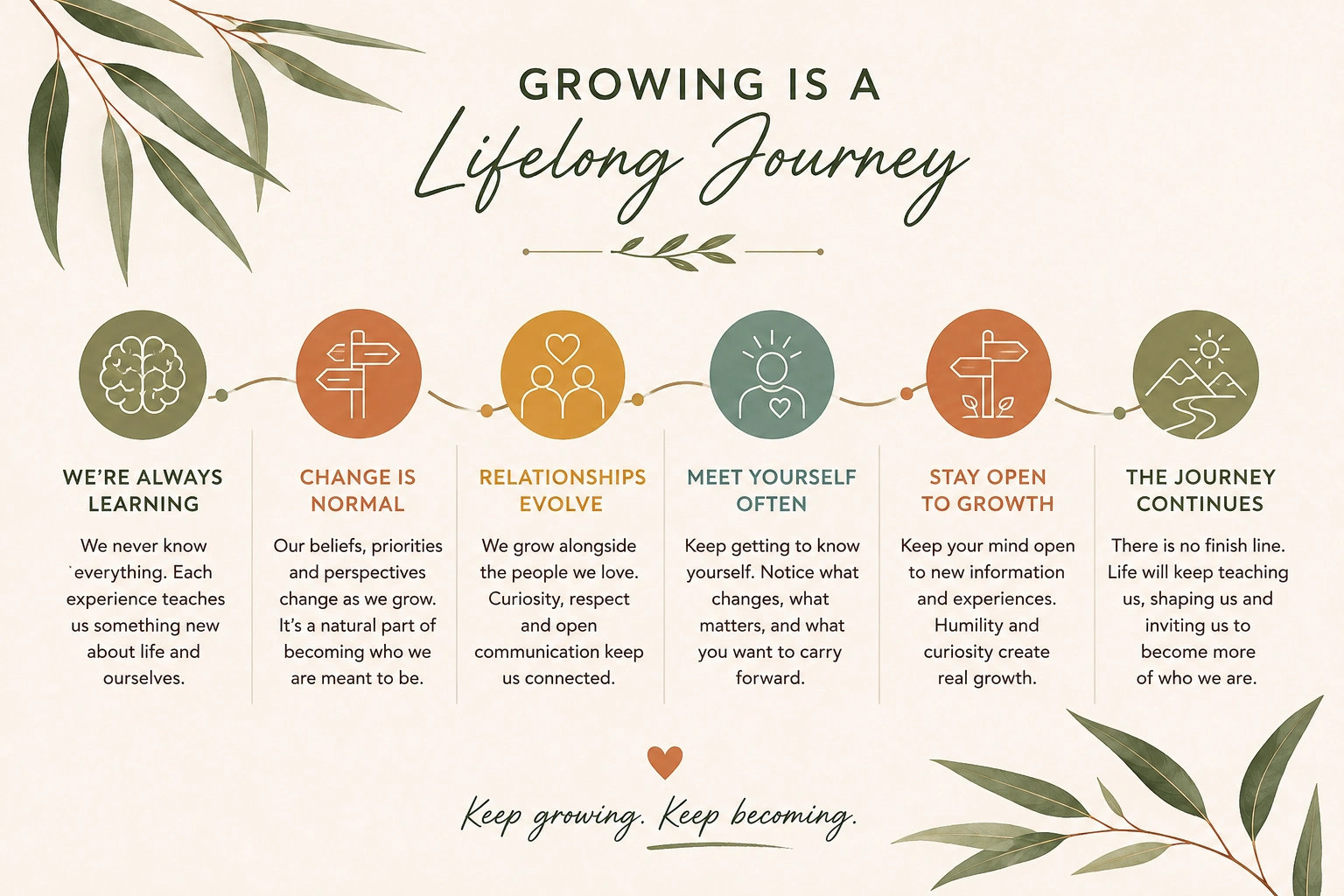
Perhaps lifelong growth is best understood as an ongoing relationship with yourself. You are not a finished product waiting to be perfected, and you are not required to remain loyal to every version of yourself you have ever been. The person you are today has been shaped by everything you have lived through, but those experiences don’t have to determine every experience that comes next.
You can question yourself without attacking yourself. You can change your mind without deciding that your former self was foolish. You can learn something uncomfortable without turning it into a verdict on your character. You can discover that you were wrong and still respect the person who was doing the best they could with what they knew at the time.
Perhaps the same generosity can extend to the people around you. Your partner is still becoming someone. Your children are still becoming themselves. Your friends are changing in ways you may not always understand immediately. So are you. The people we love cannot remain frozen in the versions we first knew, and neither can we.
Growing is not something we finish. It is part of what it means to be alive. There will always be experiences we haven’t had, things we haven’t understood and aspects of ourselves we haven’t yet encountered. Knowing yourself is therefore a lifelong journey, not because you are endlessly broken and need fixing, but because you are never entirely finished becoming.