Self-awareness & relationships
Lying to Others: What We Protect, Avoid and Risk When We Aren’t Honest

There are lies we tell because we are afraid. There are lies we tell because we want something, because we don’t want to hurt someone, or because the truth might change what happens next. And sometimes we lie because telling the truth would require us to face something about ourselves that we’d rather not see.
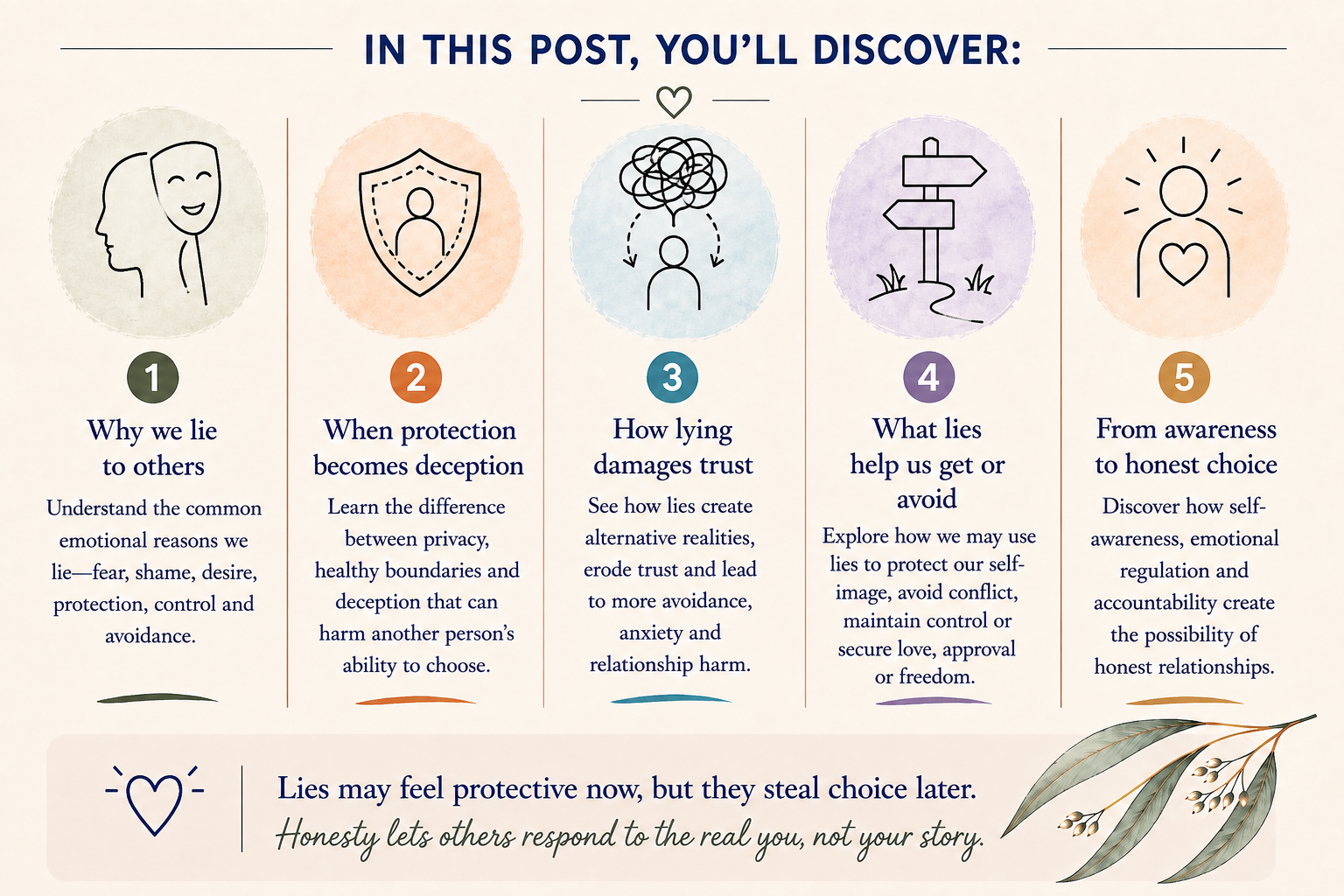
Lying is part of being human. Almost everyone has done it at some point. Some lies are small and socially harmless; some protect privacy or keep us safe in circumstances where telling the truth could have serious consequences. We might soften an uncomfortable opinion because we care about someone’s feelings, or say we’re fine when we aren’t because we don’t have the energy to explain what is really going on.
Then there are the lies that begin to change the nature of a relationship.
A lie can start as a moment of avoidance. The problem is that avoidance rarely stays contained. One explanation needs another explanation, which creates another question, which requires another version of the story. Eventually, the person who is lying may find themselves managing an entire alternative reality rather than dealing with the original problem.
That is where lying becomes more interesting than a simple question of whether someone is honest or dishonest. The more useful question is what the lie is doing.
Relationship Sanity isn’t about demanding complete transparency from everyone. We are entitled to privacy. We are entitled to boundaries. We don’t owe other people access to every thought, feeling or experience we have. Nor is the purpose of understanding lying to excuse it.
It is to understand what happens underneath it. Because if a pattern of lying is going to change, knowing that lying is harmful isn’t usually enough. We have to understand what the person is trying to protect, avoid, control or obtain when they lie.
Why do people lie?
The reasons are surprisingly ordinary.
A child denies eating the chocolate because they are afraid of getting into trouble. A teenager says they are studying when they are actually talking to friends because they want some independence without having to deal with confrontation. An employee says they’re fine when they’re overwhelmed because admitting that they are struggling feels like admitting they aren’t capable. A friend says they love someone’s new haircut because they don’t want to hurt their feelings.
An adult might tell themselves that they are happy in a relationship because acknowledging that they aren’t would create a frightening number of decisions.
The circumstances are different, but the emotional ingredients often overlap: fear, shame, avoidance, desire, insecurity, protection, control, belonging and, sometimes, simple habit. Lying can be a way of getting something we want, but it can also be a way of getting away from something we don’t want to feel.
That distinction matters because the same behaviour can have very different psychological origins. Someone who lies because they are terrified of being rejected may need to learn to tolerate rejection. Someone who lies because they want to control another person’s decisions is dealing with a different problem. The behaviour is similar; the underlying relationship dynamic isn’t.
When protection becomes deception
Not every lie carries the same meaning, and context matters.
There is an important difference between lying because you are trying to protect yourself from immediate danger and deliberately deceiving someone for your own advantage. There is also a difference between privacy and deception. You are allowed to say, “I don’t want to talk about that,” and you are allowed to keep parts of your inner life private.
The line becomes more significant when the information being withheld is relevant to another person’s choices.
If your partner asks how much you spent on a pair of shoes and you don’t want to discuss your spending, that may be a private matter or a boundary, depending on the circumstances of the relationship. Deliberately hiding substantial debt when you are jointly making financial decisions is something else entirely. The difference isn’t simply that one person withheld information. It is what that withholding does to the other person’s ability to make an informed choice.
That distinction becomes particularly important in intimate relationships, where people’s decisions are often interconnected. Sometimes the question isn’t, “Am I entitled to keep this private?” It is, “Does the other person have a reasonable right to know this because it affects them?”
When do we lie?
People are especially likely to lie when the perceived cost of telling the truth feels greater than the perceived cost of lying.
That calculation can happen almost instantaneously. If I tell them, they’ll be angry. If I admit this, they might leave. If I tell the truth, I’ll look stupid. If they know what I really want, they’ll judge me. If I say no, they’ll be disappointed. If I admit I made the mistake, I could lose my job. If I tell my partner what actually happened, everything might fall apart.
So we choose the immediate relief of the lie.
And that relief is one of the reasons lying can become so persistent. It works, at least for a moment. Anxiety drops. An argument is postponed. Someone’s approval is preserved. A difficult conversation disappears from today’s agenda.
The trouble is that the original problem hasn’t disappeared. It has simply been moved into the future, often carrying interest.
The short-term reward of lying
Lying can be surprisingly effective in the short term, which is precisely why it can become habitual. If telling the truth produces anxiety and lying produces immediate relief, the nervous system learns something very quickly: that worked.
But then there is a second problem. The person may have to remember what they said, keep the story consistent, avoid certain conversations and become increasingly alert to the possibility of being discovered. Questions that might once have been ordinary can begin to feel threatening. Defensiveness can appear where there used to be openness, and eventually the person may find themselves lying about the original lie.
A simple cycle can develop:
Trigger → Fear or desire → Lie → Immediate relief → Consequence → More avoidance → More lying
The original issue may eventually become almost secondary. The relationship is now dealing with the pattern created around it.
Who lies?
Everyone is capable of lying. There isn’t one particular personality type that owns dishonesty.
An anxious person can lie. So can a confident person. Someone who loves deeply can lie. Someone who is insecure can lie. A person who appears exceptionally honest in most areas of their life may still lie when a particular subject touches something they find difficult to face.
Our histories can matter too. Someone who grew up in a home where mistakes were punished harshly may have learned to conceal problems before they became visible. Someone raised around secrecy may have learned that withholding information is simply how relationships work. A person who experienced rejection whenever they expressed their needs may eventually stop experiencing honesty as a safe option.
Understanding where a behaviour came from does not remove responsibility for the behaviour. It gives us more information about what might need to change.
There is also a difference between an occasional lie and a pattern of habitual deception. I panicked and lied about something is not the same as regularly creating different versions of reality depending on who is asking the question. Some habitual liars know exactly what they are doing. Others rationalise it so thoroughly that they barely recognise the pattern anymore. For some people, managing other people’s perceptions has become so familiar that straightforward honesty feels strangely threatening.
So perhaps “Are you a liar?” isn’t the most useful question.
A more revealing one might be: What happens inside you when telling the truth becomes difficult?
What do we lie about?
In relationships, almost anything can become the subject of a lie: money, sex, infidelity, pornography, friendships, where someone has been, who they’ve been talking to, what they want, how they feel, how much they drink or spend, what happened during an argument, whether they are attracted to someone, whether they are happy, whether they have forgiven someone, whether they want children, whether they want to stay, or whether they are actually okay.
Sometimes people lie about what they did. Sometimes they lie about what they didn’t do. Sometimes they leave out information because they know the other person would draw a different conclusion if they knew the whole story.
That last form can be particularly difficult to recognise because every individual sentence may sound defensible.
The half-truth
Imagine someone saying, “I didn’t sleep with her.”
Technically, that might be true. But suppose they kissed her, stayed at her house overnight, exchanged intimate messages and deliberately left all of that out because they knew their partner would interpret the situation differently if they knew.
The issue isn’t whether the sentence can survive a technical examination. The issue is whether the person was deliberately creating a false understanding.
Communication isn’t only about the literal accuracy of individual sentences. In a relationship, what matters is also whether the other person is being given enough truthful information to understand what is happening and make meaningful decisions about it.
Lying in intimate relationships
Lying becomes especially complicated when love, attachment and vulnerability are involved because there is usually more to lose.
The person whose opinion matters most can also be the person whose rejection hurts most. The relationship we most want to preserve can become the relationship in which honesty feels most dangerous. We might fear losing the person, disappointing them, provoking conflict, exposing ourselves or discovering that the relationship cannot withstand the truth.
This is where emotional intelligence becomes relevant. Before we can communicate honestly with another person, we often need to understand what is happening inside ourselves.
What am I afraid will happen if I tell the truth? What am I trying to protect? What am I trying to get? What am I avoiding? Am I protecting myself, or am I protecting the relationship from information it actually needs? Am I maintaining privacy, or am I creating a false reality?
These questions move us beyond the fairly unhelpful conclusion that “lying is bad” and towards something more useful: understanding the behaviour well enough to change it.
A story about money and identity
Consider Arjun, who moved from India to Melbourne for work and eventually began a serious relationship. He had always been proud of being financially responsible, so when his partner asked how much money he had saved, he exaggerated the amount. It was a small lie, and he fully intended to correct it later. As the relationship became more serious, however, correcting it became increasingly difficult.
When they began discussing buying a home, Arjun avoided conversations about finances. When his partner asked again, he became defensive. Eventually she discovered the truth, and the problem was no longer simply the amount of money he had or hadn’t saved. The lie had become part of the relationship.
What Arjun eventually recognised was uncomfortable. He hadn’t only been protecting information about his finances. He had been protecting his identity as the financially successful, dependable partner. Telling the truth meant allowing someone he loved to see him as imperfect.
His work, then, was not simply to apologise. He had to learn to tolerate the discomfort of being known without being certain that the other person would always see him in the way he wanted to be seen.
That is a different skill from simply learning to say, “I’m sorry.”
When “I’m fine” isn’t fine
Megan lived in Durbanville and had been married for several years. Whenever her husband asked how she was, she said everything was fine. It wasn’t. She was unhappy, increasingly resentful and emotionally disconnected, but she didn’t want to become “the person who broke up the family,” so she kept saying that work was stressful, she was tired and they were okay.
Eventually she realised something important: she wasn’t lying because she didn’t know how she felt. She was lying because she did know. What she didn’t know was what she wanted to do about it.
For Megan, honesty had to begin before the conversation with her husband. She first had to stop using “I’m fine” to avoid her own reality. Sometimes that is where the first honest conversation happens: privately, when we finally stop negotiating with ourselves about what we already know.
The person who kept saying, “I’m over it”
Daniel’s relationship ended badly in New York. When friends asked how he was doing, he laughed and said, “I’m over it.” He wasn’t. He was angry, embarrassed and still hoping his former partner would come back.
He started dating again and told himself he was ready. The people he dated experienced something different. He was emotionally unavailable, even though Daniel genuinely believed he was giving himself another chance.
Eventually someone said to him, “You keep telling me you’re over your ex, but everything you do seems organised around proving it.”
That stopped him because it exposed something he hadn’t quite seen. He wasn’t necessarily deliberately deceiving people. He was communicating a version of himself he desperately wanted to be true.
His work became less about convincing everyone that he was okay and more about becoming honest about where he actually was.
The lie that made the problem bigger
Emily, a university student in Ohio, missed an important assignment deadline and told her professor that her laptop had failed. It hadn’t. She had been overwhelmed, procrastinating and afraid that admitting she was struggling would make her look irresponsible.
The lie worked temporarily. Then she had to remember the details, explain why she hadn’t reported the technical problem earlier and manage the growing anxiety about being found out. Eventually the story required more energy than telling the truth would have required in the first place.
When Emily finally admitted what had happened, there were still academic consequences. Telling the truth didn’t magically erase them. What surprised her was that the catastrophe she had imagined did not occur.
She learned something that many people discover only after making the same mistake several times: avoiding a consequence can sometimes create a much larger one.
“I’m coping”
Sophie had recently become a mother. Whenever people asked how she was doing, she said she was great. In reality, she was exhausted and overwhelmed and struggling with the enormous change in her identity. She was frightened that admitting this would make people think she wasn’t grateful for her baby.
So she smiled, said she was coping and told her partner she was fine.
Eventually she realised that her “I’m fine” was doing something quite practical: it was preventing the people around her from knowing what she actually needed. Her honesty began with a relatively ordinary sentence: “I’m not coping as well as I keep saying I am.”
There was no dramatic confession. But the conversation that followed was different because other people finally had access to the reality she was living.
Honesty isn’t always about revealing a scandal. Sometimes it is simply allowing someone to respond to the person who is actually in front of them.
When shame gets involved
Aoife had been through a painful breakup in Ireland. Her former partner had repeatedly criticised her appearance, friendships and judgement. When friends asked why she had stayed so long, she said, “I knew exactly what he was like.”
She didn’t. Or at least, that wasn’t the whole truth.
She had ignored things. She had explained things away, accepted apologies and changed parts of herself in the hope that the relationship would improve. Afterwards, she initially turned all of that into evidence against herself: I should have known better.
Eventually she began asking a different question: What did I need to believe about myself to stay in that relationship?
That question allowed her to examine her choices without turning them into a verdict on her intelligence or worth. She could acknowledge what she had ignored and what she would do differently without deciding that she was stupid for having been there.
Shame often makes honesty harder because it turns behaviour into identity. Self-awareness gives us another option.
When keeping the peace becomes its own kind of dishonesty
Wei had moved to Belgium and was building a life far from home. In his relationship, he avoided difficult conversations. When his partner asked what he wanted, he often replied, “Whatever you want.”
It sounded generous. It wasn’t always true.
Sometimes he had strong preferences. Sometimes he disagreed. Sometimes he was angry, and sometimes he was afraid that expressing his needs would create conflict. Over time, his partner began telling him, “I don’t know what you actually want.”
Wei hadn’t set out to manipulate her. He had mistaken conflict avoidance for kindness, but the effect was still significant. His partner couldn’t make fully informed choices about the relationship because she wasn’t receiving an honest picture of his needs.
He began practising something much more uncomfortable than saying “whatever you want”: “I don’t agree.” “I need some time.” “I actually want something different.” “I’m worried you’ll be angry if I tell you this.”
For Wei, honesty became less about confrontation and more about actually being present in the relationship as himself.
When you say you want one thing but hope for another
After her divorce, Hannah moved to a new city in New Zealand and began dating again. She told potential partners she was completely comfortable with casual relationships, although what she actually wanted was commitment. She was afraid that admitting this would make her seem needy, so she accepted arrangements that didn’t meet her needs and then felt rejected when they ended.
Eventually she recognised the contradiction. She was telling people she wanted one thing while privately hoping they would offer her another.
The uncomfortable realisation was also liberating: If I don’t tell people what I actually want, I can’t fairly blame them for not giving it to me.
Once she became more honest about what she wanted, not everyone was interested. That was disappointing, but it was useful information. The people who wanted the same kind of relationship became much easier to recognise.
Why do we lie to people we love?
Because love doesn’t remove fear. In some ways, it gives fear more to work with.
We may fear losing the relationship, being judged, disappointing someone, being abandoned, provoking conflict or discovering that the relationship cannot survive the truth. Sometimes the fear is even more personal: What if they see the real me and decide I’m not enough?
This is where lying intersects with attachment, self-worth, shame and emotional regulation. A person who cannot tolerate another person’s disappointment may lie to prevent it. Someone who experiences conflict as overwhelming may lie to avoid it. Someone who cannot tolerate shame may hide what happened before anyone has a chance to judge them.
The lie changes. The emotional problem underneath it may be remarkably similar.
Lying, shame and self-worth
Shame deserves particular attention because it can make honesty feel dangerous.
Guilt says, “I did something wrong.” Shame says, “There is something wrong with me.” When shame takes over, admitting what happened can feel like handing someone evidence that we are fundamentally bad, selfish, inadequate, stupid or unlovable.
That can produce all sorts of defensive behaviour. We minimise. We deflect. We blame. We rationalise. We hide. We attack the person asking questions. Or we lie.
This is why simply telling someone to “just be honest” isn’t always enough. Honesty requires the ability to tolerate what honesty might bring: discomfort, disappointment, anger, consequences and sometimes loss. If the emotional price of truth feels unbearable, deception can become a form of emotional escape.
The answer isn’t to remove all consequences. It is to become more capable of tolerating them without needing to distort reality.
Lying as emotional regulation
There is another psychological mechanism worth understanding. For some people, lying functions as a way of regulating difficult emotion.
A partner asks a confronting question. Anxiety rises. The person lies. The anxiety drops.
That reduction in distress can reinforce the behaviour. The brain has learned that lying made an uncomfortable feeling go away, at least temporarily. The next time a similar situation occurs, the same response is more readily available.
This is one reason changing a pattern of lying can be harder than simply deciding to “be more honest.” The person may be changing the way they respond to fear, shame, conflict and uncertainty, not merely changing a communication habit.
If the underlying emotional regulation problem remains untouched, a person may stop lying about one subject and begin lying about another.
Honesty and boundaries
There is a danger in talking about honesty as though healthy relationships require unlimited access to each other’s inner lives. They don’t.
You can say, “I don’t want to discuss that.” You can say, “I’m not ready to talk about it.” You can say, “That’s private,” or “I need some time before I answer.”
Those are honest boundaries.
The alternative to deception isn’t necessarily total disclosure. Often it is simply telling the truth about the boundary itself. There is a significant difference between saying, “I don’t want to tell you about that,” and inventing a false explanation because you know the truth might affect the other person’s decision.
The first preserves privacy. The second may be managing another person’s reality.
When sex, consent and fidelity are involved
Some forms of deception carry particularly serious consequences because they affect another person’s ability to make informed choices about their own body, sexual health and relationships.
People may lie about sexual history, pornography, messages with another person, affairs, contraception, STI testing or whether another sexual relationship exists. These are not merely communication problems. Relevant information can affect consent itself.
This is where the distinction between Relationship Intelligence and Sexual Intelligence becomes important. Consent is not simply about obtaining a yes or no in a particular moment. Meaningful consent depends on people being able to make their own choices with relevant information available to them.
Deception that deliberately removes information another person reasonably needs can therefore become an issue of autonomy, not simply honesty.
When lying becomes manipulation
Not every lie is equally harmful, and motivation matters.
There is a meaningful difference between someone saying, “I panicked and lied because I was terrified of your reaction,” and someone thinking, “If they know the truth, they’ll make a different decision, so I’ll make sure they don’t find out.”
The second is about control.
Deception can be used to manipulate another person’s choices, maintain financial control, conceal sexual behaviour, deny events that happened or repeatedly undermine someone’s confidence in their own perception. When lying becomes part of a broader pattern of manipulation or gaslighting, the issue is no longer simply whether someone needs to become more honest. Power, autonomy and safety have entered the picture.
Understanding why someone behaves this way does not create an obligation to tolerate it.
That distinction matters throughout Relationship Sanity: understanding behaviour is not the same as excusing behaviour.
What happens when trust is damaged?
Trust is often described as believing that someone won’t hurt us. In relationships, it is broader than that. Trust also involves being able to rely on another person’s account of reality.
Can I believe what you tell me? Can I make decisions based on the information you give me? Can I express something vulnerable without having it distorted? Can I trust that your yes means yes and your no means no? Can I raise a difficult subject without having the conversation turned into another layer of deception?
Repeated lying damages these forms of trust. Eventually, even truthful statements can become difficult to believe, because the other person no longer has a reliable way of knowing which version of reality they are being given.
That is one of the crueler consequences of repeated deception. The problem eventually becomes larger than the original lie.
Can the pattern be changed?
Yes, but there is an uncomfortable qualification: the person doing the lying has to want to change it.
A partner cannot love someone into honesty. A therapist cannot force it. Shame certainly doesn’t produce reliable honesty. If someone believes deception is working for them and doesn’t see a reason to change, another person may have very little power to alter the behaviour.
Change begins when the person becomes willing to examine the pattern. What am I afraid will happen if I tell the truth? What am I trying to protect? What am I trying to get? What consequence am I avoiding? What do I believe will happen if I stop managing this person’s perception of me? What does my behaviour cost the other person, and what does it cost me?
Eventually, there is a harder question underneath all of those: What would I have to tolerate if I stopped lying?
The answer might be someone’s disappointment. It might be conflict. It might be embarrassment, uncertainty, consequences or the possibility that the relationship changes.
Sometimes that is precisely what the person has been trying to avoid.
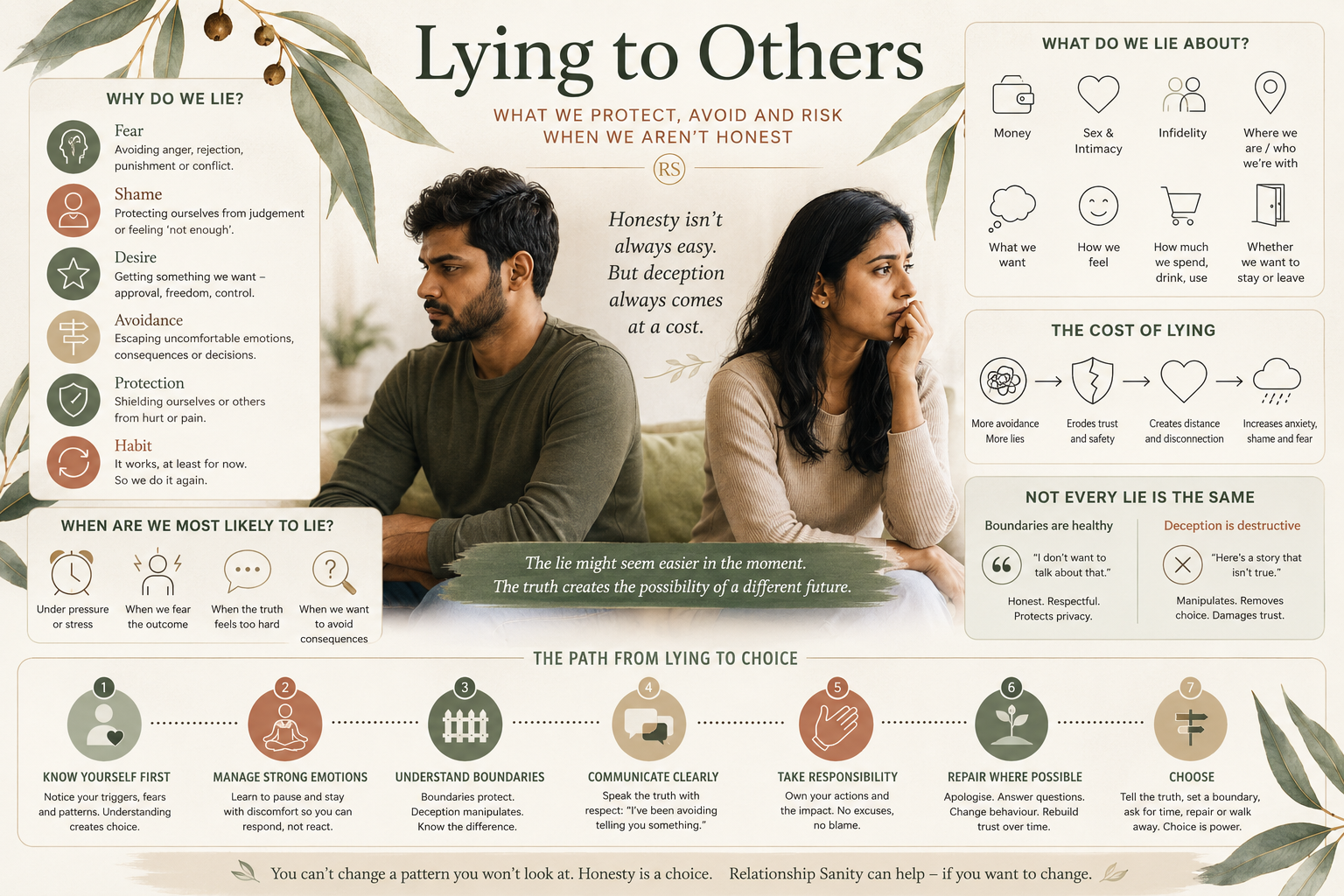
The Relationship Sanity approach
There isn’t a single formula for becoming honest, and honesty without emotional regulation can sometimes become impulsive disclosure rather than good communication. What matters is developing enough self-awareness to understand what is happening before choosing how to respond.
Know Yourself First. Pay attention to the situations in which you become defensive, evasive or tempted to hide. What subjects reliably make you want to change the story? What emotions appear just before you do it? Understanding the trigger doesn’t excuse the lie, but it gives you something concrete to work with.
Manage Strong Emotions. If fear, shame or anger immediately overwhelms you, telling the truth may feel impossible. Learning to tolerate an uncomfortable emotion for long enough to respond deliberately can make honesty more achievable. Sometimes the most useful sentence is simply, “I need a little time before I answer this honestly.”
Understand Your Boundaries. You don’t have to disclose everything. But know the difference between protecting a legitimate boundary and deliberately creating a false impression. “I’m not prepared to discuss that” is honest. Inventing a story to make sure someone doesn’t know is different.
Communicate Clearly. Honesty can sound remarkably ordinary. “I’ve been avoiding telling you something.” “I wasn’t truthful about that.” “I was afraid of your reaction.” “I told you what I thought you wanted to hear.” “I actually want something different.” None of these sentences guarantees a pleasant conversation, but they at least allow the other person to respond to what is real.
Take Responsibility. Understanding why you lied matters, but so does recognising the effect of the lie. “I was afraid” explains something about your behaviour; it doesn’t erase its impact. Accountability means being able to say, “I did this,” without immediately needing to add, “but you made me.”
Repair Where Possible. An apology is only one part of repairing damaged trust. Sometimes repair means answering questions honestly, accepting consequences, changing behaviour and allowing the other person to decide what they need. Trust is generally rebuilt through repeated experiences of reliability. Promises can begin that process, but patterns are what sustain it.
And then there is choice. Once we understand the pattern, we can decide what we are willing to do differently. We might tell the truth, ask for time, set a boundary, accept a consequence, attempt repair or recognise that we aren’t currently willing to change. Choice doesn’t guarantee the outcome we want. It does mean we stop pretending we have no part in what happens next.
Honesty does not guarantee a happy ending
This may be one of the hardest things to accept about honesty: telling the truth does not guarantee that the relationship will survive it.
Sometimes honesty saves a relationship. Sometimes it reveals a problem that can be repaired. Sometimes it exposes an incompatibility that was already there. Sometimes it ends the relationship.
The person you tell may be angry. They may leave. They may need time. They may decide that the trust between you has been damaged beyond what they are willing to repair. There may be consequences you were trying to avoid in the first place.
Honesty isn’t a technique for getting the outcome you want. It is a way of relating to reality.
That brings us back to acceptance. If you lied, you lied. If you are unhappy, you are unhappy. If you want something different, you want something different. If you broke someone’s trust, that happened. If someone else’s deception has damaged your trust, that happened too.
You don’t have to like the truth before you can acknowledge it.
What if you don’t want to stop lying?
That possibility deserves to be taken seriously too.
Relationship Sanity isn’t a moral authority demanding radical transparency from everyone. People have autonomy, and some people will choose not to change. They may decide that the benefits they receive from deception are worth the consequences. That is their choice.
But the other person has choices as well.
You can decide what behaviour you are willing to accept. You can establish boundaries. You can decide what information you need in order to participate in a relationship. You can decide what constitutes a deal-breaker, and you can leave a relationship in which trust has become impossible.
That is part of Relationship Sanity too. We aren’t only responsible for understanding our own behaviour; we also have the right to make decisions based on what someone else’s behaviour tells us.
What is the lie trying to accomplish?
Perhaps the most useful question isn’t simply, “Why did you lie?”
Try looking underneath the behaviour.
Was the lie trying to protect you from fear? Was it protecting someone else’s feelings? Was it avoiding shame or conflict? Was it trying to secure approval, preserve an identity, maintain control, keep a relationship or create freedom without having to negotiate for it? Was it hiding something you knew another person had a reasonable right to know?
The answer matters because the lie is often solving a problem, at least temporarily. If we understand the problem, we have a better chance of finding another way to deal with it.
Someone who lies to avoid conflict may need to learn that disagreement can be survived. Someone who lies to avoid rejection may need to become more comfortable with hearing no. Someone who lies because mistakes trigger overwhelming shame may need to discover that accountability doesn’t require self-destruction. Someone who lies to maintain an image may need to learn how to tolerate being known as imperfect.
And sometimes the truth reveals something less comfortable: the person is lying because they want the benefits of another person’s trust while avoiding the responsibility that trust requires.
That is worth facing too.
From lying to choice
The goal probably isn’t to become a person who never feels afraid enough to lie. Human beings are more complicated than that.
The more useful goal is to become aware of the moment when the choice appears. There is a point, often very brief, when we know we could avoid the discomfort by changing the story. We could lie. We could omit something important. We could give a half-truth. We could make the other person believe something that isn’t quite true.
Or we could pause long enough to understand what we are afraid of, decide whether we need a boundary, and tell the truth.
That doesn’t mean honesty will be easy, and it certainly doesn’t mean honesty will always produce the outcome we want. It means we are willing to let another person respond to reality rather than to a version of reality we constructed for them.
That is a significant part of relationship intelligence.
Healthy relationships aren’t built by never making mistakes. They are built through the capacity to recognise what we are doing, understand why we are doing it, take responsibility for its effects and, when we are willing, make a different choice.
Relationship Sanity cannot make someone tell the truth. No framework can do that. But if you want to change a pattern of lying, understanding what sits underneath the lie can give you somewhere much more useful to begin.
Sometimes the first person we need to tell the truth to isn’t another person.
It is ourselves.
“This is what I am doing. This is what I am afraid of. This is what I have been trying to protect. And this is what I am willing to do next.”