Self-awareness & relationships
Lying to Ourselves: The Emotions That Keep Us From the Truth

Sometimes the hardest person to be honest with is ourselves. That isn’t necessarily because we are deliberately dishonest; quite often, the truth threatens something we care about deeply. It might threaten a relationship we desperately want to keep, the hope that things will eventually change, our sense of control, or the belief that we are a sensible person who makes good decisions. Sometimes it threatens something even more personal: the way we understand who we are.
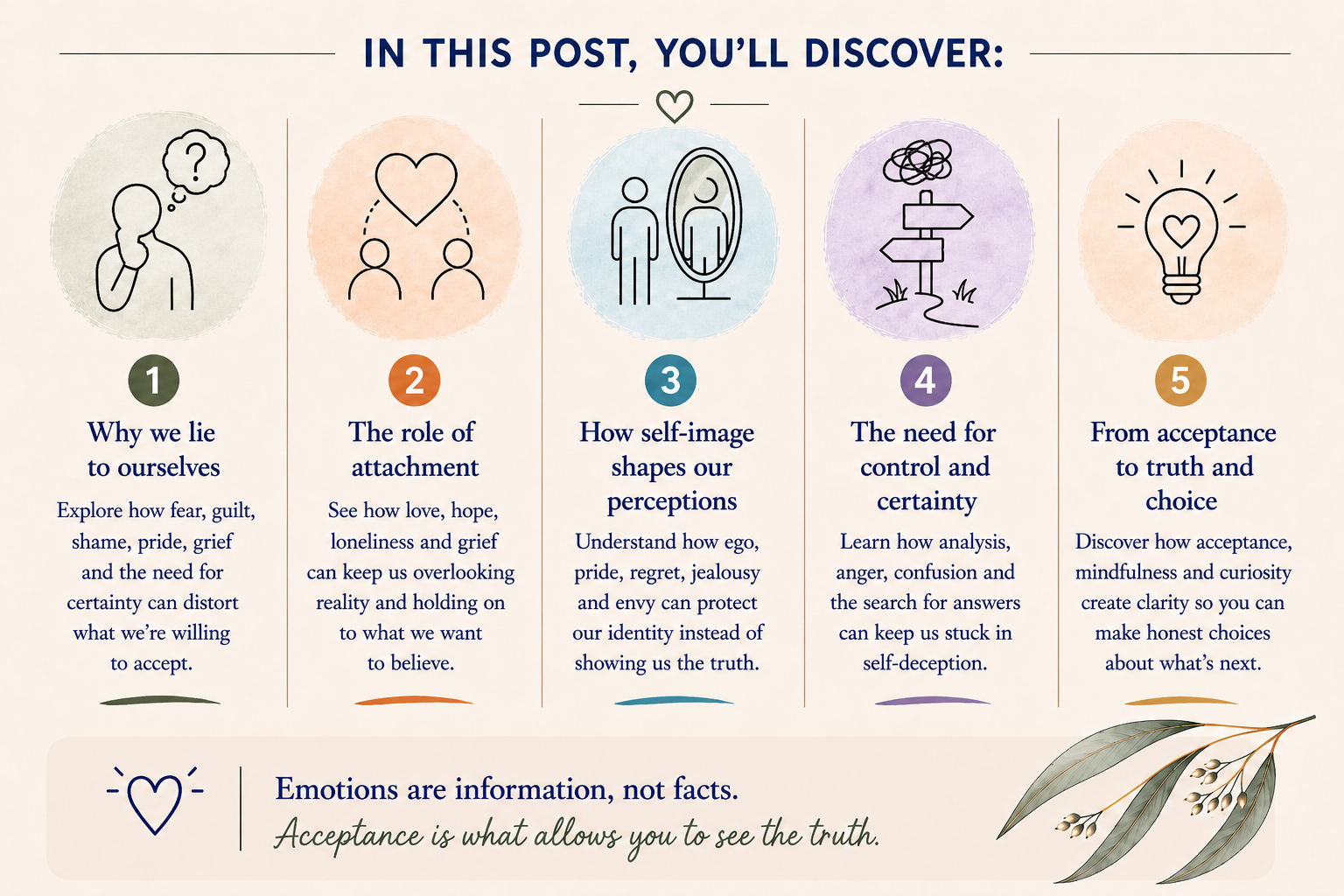
When reality becomes emotionally difficult, the mind has several ways of making it easier to live with. We can minimise what happened, rationalise our behaviour, blame someone else, justify a decision, focus on another person’s shortcomings or selectively remember the parts of the story that support the version we would prefer to believe. Usually, this isn’t a conscious decision to lie to ourselves. Something in us is trying to protect us from what the truth might make us feel, and sometimes from what accepting the truth might require us to do.
That is why self-deception is more interesting than the idea of simply being dishonest. We are emotional beings, and our emotions don’t just respond to the reality around us; they can influence which parts of reality we are willing to see.
The emotional architecture of self-deception
It is tempting to think of lying to ourselves as a character flaw. If we aren’t being honest about a relationship, a mistake or our own behaviour, surely we should simply admit the truth. In practice, human beings don’t work quite that neatly. We interpret what happens through our history, beliefs, attachments, fears, expectations and sense of identity, so when reality threatens something important, our emotional system can become involved in deciding what we are prepared to acknowledge.
The resulting story can feel completely true because, emotionally, it may be safer than the alternative. A person may genuinely believe that their partner is going to change, that an argument was entirely the other person’s fault, or that staying in a painful situation is still the best option. The belief isn’t necessarily fabricated consciously; it may have developed because accepting another interpretation would involve fear, grief, shame, uncertainty or a decision they aren’t ready to make.
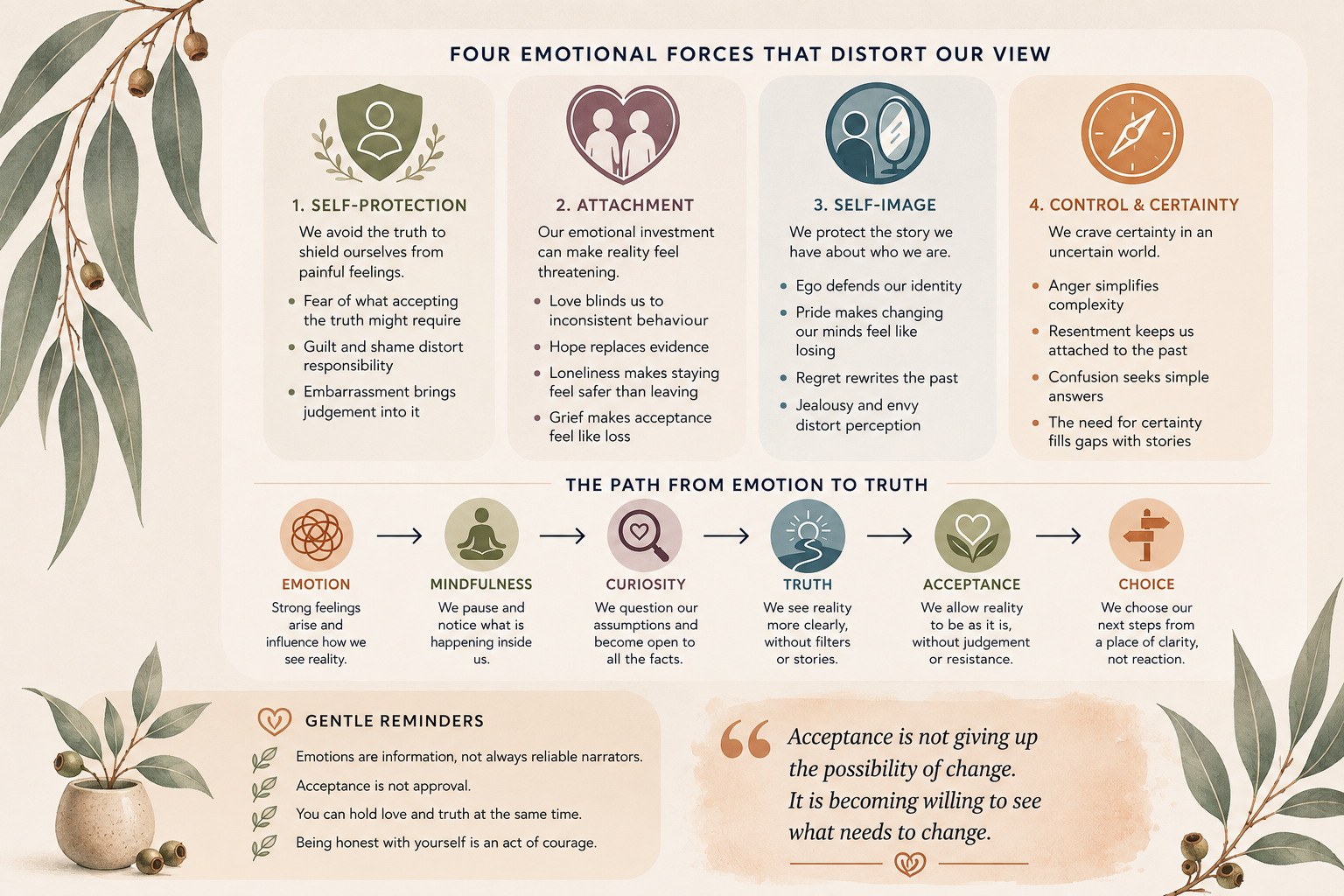
There are four broad areas where this can happen: self-protection, attachment, self-image, and our need for control and certainty. They overlap considerably, and the same situation can involve several of them at once.
1. Self-protection
When reality feels threatening, some degree of psychological protection is entirely understandable. Fear, guilt, shame and embarrassment can help us manage experiences that feel overwhelming, and sometimes we genuinely need time before we are able to face something fully. The difficulty begins when a protective response continues long after it has stopped helping us, because what once softened the impact of reality can eventually prevent us from seeing reality clearly.
Imagine knowing, somewhere underneath everything, that a relationship is hurting you. Acknowledging that might mean confronting the possibility that the relationship needs to change, that someone you love isn’t who you hoped they were, or that you have stayed longer than you intended. It may be easier, at least temporarily, to tell yourself that things aren’t that bad, that everyone has problems, that your partner is under pressure, or that you are probably overreacting.
Fear is often at the centre of this process. Sometimes we don’t avoid the truth because we don’t know it; we avoid it because we have a fairly good idea of what accepting it might require. If I admit this relationship is unhealthy, what happens next? If I accept that this person doesn’t love me in the way I need, what do I do with that? If I acknowledge that I made the wrong decision, what will other people think? If I accept that I cannot change them, what am I left with? Those questions can make denial feel remarkably attractive.
Guilt can work differently. Healthy guilt can tell us that our behaviour has moved away from our values and can motivate us to repair the damage, but guilt can also distort our view of responsibility. We might minimise what we did, focus on what someone else did first, blame circumstances, or swing in the opposite direction and take responsibility for things that were never ours to carry. Acceptance requires something more accurate than either extreme: an honest look at what was ours, what wasn’t, and what we can learn from it.
Shame makes the situation even more difficult because it turns an experience into a judgement about identity. Guilt says, I did something wrong, while shame says, There is something wrong with me. If accepting the truth means having to see ourselves as stupid, weak, needy, gullible, damaged or unworthy, it is hardly surprising that part of us might defend against that truth; we may become more interested in preserving our innocence than understanding what actually happened.
Embarrassment has its own influence because it brings other people’s imagined judgement into the picture. What if they know I didn’t see the signs? What if they know I stayed? What if they realise I was wrong? What if they know how badly I wanted to be loved? Sometimes we hide the truth from other people, but sometimes we have already begun hiding it from ourselves because fully acknowledging what happened would mean fully experiencing the humiliation of it.
Acceptance begins to change this dynamic when we can recognise the protection without attacking ourselves for needing it. We can become curious about whether the story we are telling ourselves is still helping us cope, or whether it has become something that keeps us from seeing clearly and moving towards the life or relationship we actually want.
2. Attachment
Some of the strongest distortions don’t come from fear at all. They come from attachment, because once we are emotionally invested in someone or in a future we have imagined, seeing reality clearly can feel like threatening the very thing we are trying to preserve.
Love, hope, loneliness, grief and desire can all influence what we notice and how we interpret it. We may overlook evidence, explain away behaviour, minimise our needs or continue believing in someone’s potential long after their consistent behaviour has begun telling us something different. Attachment doesn’t make us weak or irrational; it makes us human, but there are times when our determination to preserve the connection becomes stronger than our willingness to examine the relationship honestly.
Love
When we love someone, we don’t necessarily see them objectively, and perhaps nobody sees the people they love objectively. We know their history, remember their kindness, understand their vulnerabilities and carry memories of times when the relationship felt wonderful, all of which can make it difficult to hold the less comfortable parts of the picture alongside the good ones.
The trouble comes when compassion starts doing the work that discernment is supposed to do. We might think, They didn’t really mean it. They’re under pressure. Things will be different when work settles down. They’ll understand eventually. If I explain it differently, maybe they’ll finally see what I need. Another chance becomes another chance, and then another, sometimes because the evidence has changed, but sometimes simply because our hope has.
There is a subtle difference between loving someone’s potential and relating to who they consistently are. We can become attached not only to the person in front of us, but to the person we believe they could become and the future we imagine having with them. When those three things no longer match, love can make the discrepancy surprisingly difficult to accept.
Hope
Hope is valuable, and it would be a mistake to treat it as a form of self-deception in itself. Hope can help people survive difficult periods, take risks, rebuild relationships and imagine possibilities that aren’t visible yet. The problem arises when hope begins to substitute for evidence rather than exist alongside it.
Maybe they’ll change. Maybe this is just a phase. Maybe things will improve when the circumstances are different. Maybe if I try harder, they’ll understand how much this hurts. There is nothing wrong with hoping for change while acknowledging that it hasn’t happened. The difficulty is when the hoped-for future becomes more psychologically real than the present one.
Loneliness
Loneliness can alter what we are prepared to accept because the prospect of being alone can feel more frightening than the reality of staying. Someone may know that a relationship isn’t healthy and still think, At least I have someone. Maybe this is as good as it gets. Perhaps being alone would be worse.
That doesn’t necessarily mean the person believes the relationship is right for them. Sometimes connection simply feels safer than absence, even when the connection itself is painful. Acceptance allows us to acknowledge that honestly rather than turning loneliness into proof that we should stay or shame ourselves for finding it difficult to leave.
Grief
Grief is what happens when reality collides with something we deeply wanted. We can grieve a person, a relationship, an imagined future, a version of ourselves or even the belief that something was going to turn out differently.
This can make acceptance particularly difficult because accepting reality can feel like agreeing to the loss. We may keep analysing, revisiting conversations, imagining different outcomes or trying to resurrect something that has already changed. Sometimes acceptance sounds less like a positive affirmation and more like a painful recognition: This isn’t what I hoped it would be, and I am going to have to grieve that.
3. Self-image
Our sense of who we are can be one of the strongest filters through which we interpret experience. Most of us carry an internal story about ourselves: perhaps we are intelligent, independent, perceptive, emotionally aware, good at judging character or capable of handling difficult situations. When something contradicts that story, it can feel threatening in a way that goes well beyond the event itself.
Imagine someone who has always thought, I would never tolerate that kind of behaviour. Then they find themselves staying in a relationship where exactly that behaviour is occurring. The uncomfortable question isn’t only what the other person is doing; it is what the situation appears to say about them. How did I miss this? Why did I stay? Was I really as perceptive as I thought I was?
At that point, defending the story about ourselves can become more important than examining what happened. Ego, pride, regret, jealousy and envy can all influence that process because they are connected to dignity, competence, worth and identity. Sometimes it is emotionally easier to say, They completely manipulated me, than to admit, There were things I noticed and chose not to act on. Sometimes the reverse happens and we take excessive responsibility because blaming ourselves preserves another part of our identity: If everything was my fault, at least I still have control.
Ego
Ego isn’t simply arrogance. In this context, it is the internal story we carry about ourselves and the person we believe we are. I’m intelligent. I’m independent. I have good judgement. I know people. I can recognise manipulation. I would never tolerate that.
Then something happens that doesn’t fit the story. Perhaps we trusted the wrong person, stayed too long, reacted badly or failed to recognise something that now seems obvious, and an uncomfortable tension develops between what happened and who we thought we were. The mind may respond by defending the identity rather than investigating the discrepancy.
There is nothing particularly useful about humiliating ourselves for having been wrong. A more honest response is to allow the contradiction to exist: I thought I was good at recognising this, and I missed it. That may be uncomfortable, but it also contains information we can use.
Pride
Pride can make changing our minds feel like losing. We may continue defending an argument, decision or interpretation long after we have begun to doubt it because saying, I was wrong, feels more painful than continuing to argue.
Yet changing your mind can be evidence of learning rather than weakness. Sometimes the most self-respecting thing we can do is admit that we know something now that we didn’t know before.
Regret
Regret has a particular talent for rewriting history. If only I’d left sooner. If only I’d spoken up. If only I’d listened. If only I’d known. Looking backwards, the correct path can appear obvious because hindsight has supplied information that wasn’t available at the time.
Acceptance doesn’t mean approving of past decisions or pretending there was nothing you could have done differently. It means recognising that the decision was made within the circumstances, knowledge, resources and emotional capacity you had then. You can learn from the decision without pretending that your past self had access to your present understanding.
Jealousy and envy
Jealousy and envy can distort perception because they make comparison emotionally charged. Instead of simply asking what is happening, the mind begins asking what the situation means about us: Am I enough? Am I being replaced? Are they better than me? Why do they have that and I don’t?
Once those questions become emotionally loaded, the facts can become secondary. We aren’t simply interpreting an event anymore; we are trying to protect our sense of worth from what the event might appear to say about us.
4. Control and certainty
Another powerful form of resistance comes from our desire to feel that we can understand or control what is happening. When reality feels uncertain, we often try to regain a sense of control by controlling the explanation: we analyse someone’s motives, replay conversations, search for the exact moment everything changed, imagine what we could have said differently and construct theories about what the other person was thinking.
Sometimes this kind of thinking is useful. There are situations where understanding what happened helps us make a better decision or avoid repeating a pattern. The difficulty comes when analysis becomes an attempt to obtain a level of certainty that reality simply cannot provide.
We may tell ourselves that if we find the right explanation, we will finally feel safe. If we use the right words, perhaps we can change the outcome. If we understand why someone behaved the way they did, perhaps we can prevent it from happening again. But other people remain separate human beings with their own choices, motivations and limitations, and some events simply don’t come with the explanation we want.
Acceptance asks us to distinguish between what we can influence and what we cannot. That doesn’t necessarily feel peaceful at first; sometimes accepting our lack of control feels deeply uncomfortable. Yet there is a difference between helplessly trying to control another person and deliberately choosing where our own influence can be used.
Anger
Anger can be protective. It can provide energy when we feel hurt, frightened or powerless, and it can alert us to the fact that a boundary has been crossed. But anger can also become somewhere to hide, particularly when the feelings underneath it are more vulnerable.
If I am angry, I may not have to feel how hurt I am. If I can make the other person entirely responsible, I don’t have to examine my own choices. Anger can turn a complicated situation into a simple story in which there is a clear villain and a clear victim, and sometimes that story is accurate. Sometimes someone really did behave badly. Acceptance simply asks us not to assume that anger has automatically given us the whole picture.
Resentment
Resentment can keep us psychologically attached to the past long after the event itself has ended. We replay what happened, collect evidence, revisit the injustice and construct the case again, sometimes because being right about what happened has become intertwined with our sense of what justice would require.
There are circumstances where anger and resentment point towards something that still needs to be addressed. Acceptance doesn’t ask us to pretend an injustice didn’t matter. It asks us to recognise that repeatedly fighting the reality of what already happened cannot change the past, even when the past was genuinely unfair.
Confusion
Sometimes reality really is confusing. People can behave inconsistently, relationships can contain both love and harm, and someone can be kind one day and cruel the next. We can love someone while also recognising that being in a relationship with them may not be healthy for us.
When reality is complicated, the mind naturally wants a simpler explanation. But simple isn’t always accurate, and sometimes the most honest answer is, I don’t completely understand what happened. That isn’t failure. It is uncertainty, and learning to tolerate uncertainty can be part of seeing reality more clearly.
The need for certainty
We often prefer a definite answer to an uncomfortable question, even when the answer is probably incomplete. Why did they do it? What were they thinking? Did they ever love me? Was it all a lie? Was it my fault? These questions can keep us searching long after there is enough information to make a decision.
The mind wants closure, but reality doesn’t always provide it. When uncertainty becomes intolerable, we may fill the gaps ourselves, turning assumptions into facts because an imperfect explanation feels easier to live with than not knowing. Acceptance sometimes means being able to say, I don’t know, without immediately needing to replace that uncertainty with a story.
Helplessness and powerlessness
Perhaps one of the hardest realities to accept in a relationship is that we cannot control another person’s choices. We can spend years looking for the right words, the right boundary, the right consequence, the right amount of patience or the right way to explain how much their behaviour is hurting us, all in the hope that we can produce a different response.
Sometimes the other person simply gets to make their choices. That can feel powerless, but accepting it can also return our attention to the choices that actually belong to us. We may not be able to make someone change, but we can decide what we will participate in, what boundaries we will establish and what we will do when those boundaries aren’t respected.
When emotions become distortions
None of these emotions are inherently problematic. Fear can protect us, guilt can draw attention to values we have violated, love can create connection, hope can keep us moving, anger can alert us to a boundary, pride can protect our dignity and grief can help us recognise that something has been lost.
The difficulty arises when an emotion becomes the author of reality. Fear can decide that rejection is inevitable; shame can decide that we are fundamentally defective; ego can decide that we are not allowed to admit we were wrong; love can decide that evidence doesn’t matter; anger can decide that another person is entirely responsible; hope can decide that the future matters more than the present; and the need for certainty can fill gaps in our knowledge with conclusions that feel reassuring.
The emotion is still real. The interpretation may not be the whole truth.
That distinction is important because emotional truth and factual truth are not always identical. Feeling rejected doesn’t necessarily prove that someone intended to reject you. Feeling guilty doesn’t necessarily mean everything was your fault. Loving someone doesn’t prove that the relationship is healthy, and feeling angry doesn’t automatically tell you exactly what another person’s motives were.
Emotions are information. They are not always reliable narrators.
The turning point: acceptance
So how do we become more honest with ourselves? Probably not by trying to become emotionless, and certainly not by becoming brutally self-critical. Replacing self-deception with self-punishment doesn’t make us more honest; it simply creates another reason to defend ourselves from what we don’t want to see.
Acceptance offers a different starting point. It means allowing reality to exist without immediately trying to change it, deny it, justify it or turn it into a judgement about ourselves. We can say, This happened. This is how I feel. This is what I did. This is what they did. This is what I know. This is what I don’t know. This is what I can influence, and this is what I cannot.
That may sound simple, but it is psychologically demanding because it doesn’t promise that reality will become comfortable. It asks us to stop requiring comfort before we are willing to be honest.
From emotional reaction to reality
When we are caught in a strong emotional response, it can be difficult to tell where the feeling ends and our interpretation begins. Fear may make us anticipate rejection; shame may make us see ourselves through the harshest possible lens; love may draw our attention towards someone’s potential; anger may make their behaviour seem entirely deliberate; and hope may keep us looking towards a future that isn’t reflected in the present.
None of this means the emotion is wrong. It means that an emotion can influence what we notice and the meaning we assign to it.
This is where mindfulness and curiosity can become useful. Rather than immediately believing the story an emotion is producing, we can notice what is happening internally and become interested in the assumptions attached to it. What am I feeling? What am I assuming? What information might I be overlooking? What do I actually know?
The aim isn’t to suppress the emotion or argue with it. It is to become sufficiently aware of the emotional experience that we can investigate the story surrounding it rather than automatically treating the story as fact.
The Relationship Sanity model describes this movement as:
Emotion → Mindfulness → Curiosity → Truth → Acceptance → Choice
The model isn’t suggesting that human experience always unfolds in such a neat sequence. Real life is considerably messier than that. It is simply a useful way of remembering that emotions can give us important information, mindfulness can help us notice what is happening, curiosity can help us investigate it, and acceptance can help us face reality once we have a clearer picture.
Choice comes afterwards. Once we are less entangled with the need to make reality say something different, we are in a better position to decide what we want to do about it.
The truth doesn’t have to be a punishment
Perhaps this is the part that gets lost when we talk about honesty with ourselves. Knowing something difficult about ourselves doesn’t require us to hate ourselves for knowing it.
We can recognise that we made a poor decision without deciding that we are stupid. We can acknowledge that we hurt someone without deciding that we are irredeemable. We can recognise that we stayed too long without turning that decision into evidence that we are weak. We can accept that someone treated us badly without deciding that we should have somehow known everything in advance.
There is a difference between looking honestly at ourselves and putting ourselves on trial. The first can lead to understanding and responsibility. The second often leads to defensiveness, avoidance or shame.
Acceptance is not the end of the work. It is the point where the work can become honest.
A different question
Perhaps, then, instead of asking, Why am I lying to myself?, there is a more useful question: What am I protecting myself from knowing?
What would I have to feel if I accepted this? What might I have to grieve? What would I have to admit about myself, another person or the relationship? What might I have to change? Which part of my identity would be challenged? What am I afraid will happen if I stop defending the story I have been telling myself?
Those questions aren’t invitations to interrogate yourself until you find something wrong with you. They are an opportunity to become interested in the emotional function of the story. Sometimes the story is protecting us from something we genuinely need protection from. Sometimes it is protecting us from a truth we are now strong enough to face.
And perhaps the final question is the simplest one: Can I allow the truth to exist without turning it into a judgement about who I am?
That is a very different way of approaching self-honesty. It leaves room for responsibility without shame, grief without denial, uncertainty without invented answers, and change without the demand that we first prove we were wrong to begin with.
Sometimes the bravest thing we can do isn’t leaving, confronting someone, forgiving, fighting or changing our circumstances immediately. Sometimes it is sitting still long enough to see what is actually true, even when the truth is inconvenient, painful or different from the story we have been telling ourselves.
Acceptance is not giving up the possibility of change. It is becoming willing to see what needs to change.