Relationships
Trauma Bonding: Why Can’t I Just Leave?
It’s one of the most painful questions people can ask themselves after months, and sometimes years, of feeling trapped in a relationship: If I know this relationship is hurting me, why can’t I just leave?
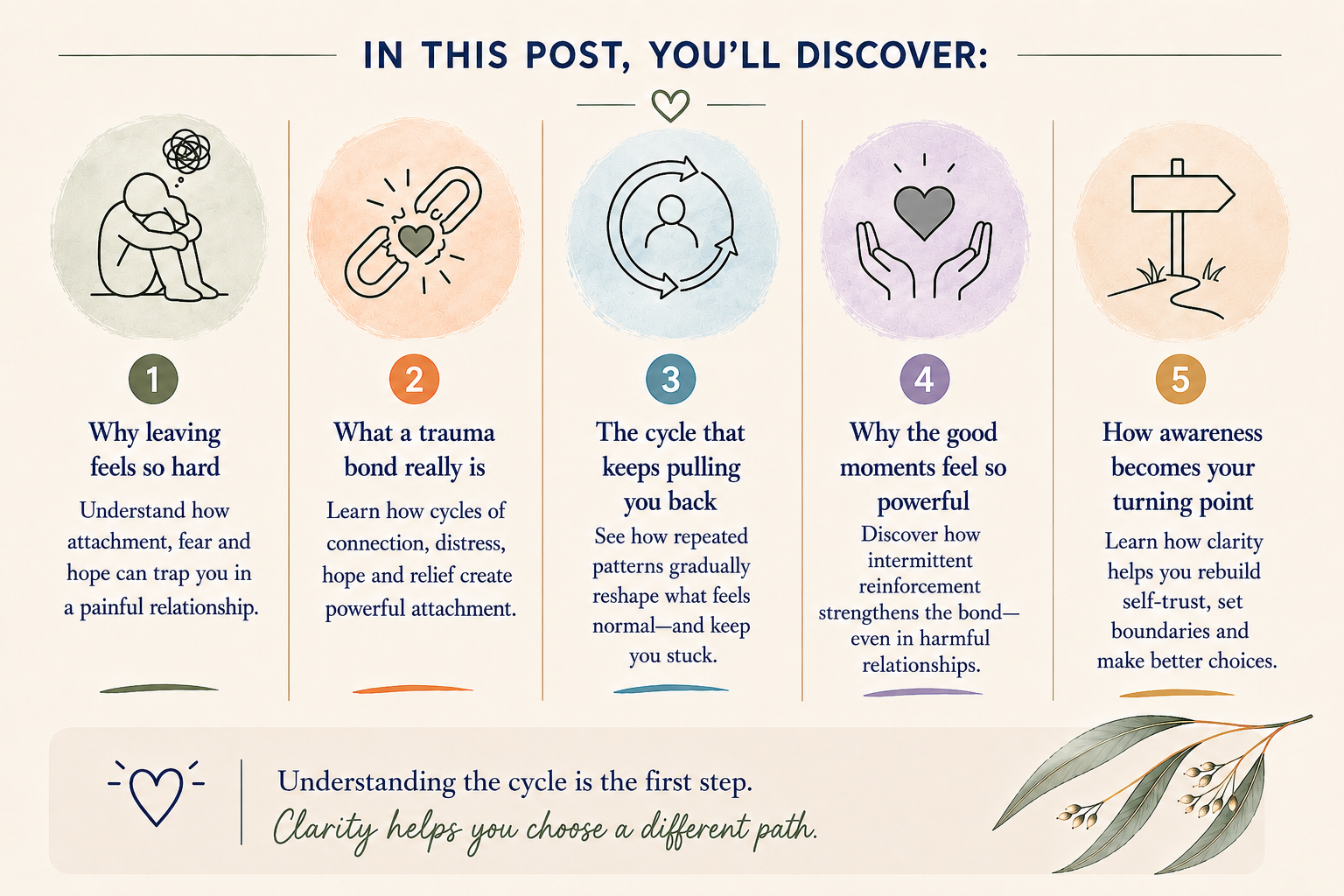
From the outside, the answer can seem obvious. If a relationship is causing you harm, surely you should be able to recognise that, make a decision and walk away. When you are the person inside the relationship, however, it rarely feels that simple. You may know, quite clearly, that something is wrong and still feel deeply attached to the person, hopeful about what the relationship could become, frightened about what will happen if you leave, or strangely compelled to return after you have finally managed to create some distance.
It is easy to turn that experience against yourself. People may wonder whether they are weak, lacking in self-esteem, too forgiving or simply incapable of making good decisions. But there is another way of looking at the question, one that doesn’t require us to excuse harmful behaviour or pretend that leaving is easy. What if the difficulty isn’t evidence that something is wrong with you, but partly a reflection of how human attachment works?
Human beings are wired for connection. Long before we have the capacity to calmly analyse whether a relationship is good for us, we develop a powerful need for attachment, security and belonging. When those needs become entangled with fear, uncertainty, dependency and repeated experiences of hurt and relief, the emotional bond can become extraordinarily difficult to disentangle.
This is part of what psychologists have explored through the concept of trauma bonding.
Where the idea of trauma bonding came from
The concept of traumatic bonding did not begin with social media or modern relationship coaching. It emerged from psychological work examining why people can remain intensely attached to relationships in which they are repeatedly harmed, and some of the early work that shaped this understanding came from psychologists Donald Dutton and Susan Painter in the late 1970s and early 1980s.
Dutton and Painter were interested in a question that professionals working with victims of domestic violence were encountering repeatedly: why can a person remain emotionally attached to someone who hurts them? Their work became associated with what was known as Traumatic Bonding Theory, which examined the role of attachment, power imbalances and cycles of abuse in creating unusually strong emotional bonds. Their thinking also built on the earlier work of John Bowlby and Attachment Theory, which proposed that human beings are biologically predisposed to seek connection and security.
Psychologist Patrick Carnes later broadened and popularised related ideas through his work on what he called betrayal bonds. His work extended the discussion beyond intimate relationships to include families, workplaces, religious organisations and other environments in which trust, dependency, power and exploitation can become intertwined.
The language has evolved since those early discussions, and trauma bonding is now used in a range of contexts. What matters for the person experiencing it is less the label itself than the possibility that there may be psychological forces operating within the relationship that make the person’s behaviour much easier to understand.
What is a trauma bond?
A trauma bond refers to a powerful emotional attachment that develops between a person and someone who repeatedly causes emotional, psychological or physical harm while also providing periods of affection, reassurance or relief. That combination is important because the relationship is not necessarily experienced as bad all the time. There may be genuine affection, intense connection, moments of tenderness, promises about the future and periods when the relationship feels exactly like the relationship you hoped it would be.
That is part of what can make the experience so confusing. If someone were cruel every minute of every day, there would be far less emotional ambiguity about what was happening. In a trauma bond, the painful experiences can exist alongside moments of closeness and hope, creating an emotional landscape in which the person may be simultaneously hurt by the relationship and deeply attached to it.
At Relationship Sanity, we define a trauma bond as “a powerful emotional attachment created through repeated cycles of connection, distress, hope, relief and uncertainty that gradually weakens a person’s ability to trust their own judgement and act in their own best interests.”
The word gradually matters. These bonds generally don’t appear overnight, and the person experiencing one may not be able to identify a particular moment when the relationship changed from something concerning into something they felt unable to leave. Often there is a much slower process in which one compromise becomes another, an explanation follows a painful incident, an apology renews hope, and a difficult period is followed by a surprisingly good one.
Over time, the relationship can become less about what is happening today and more about what happened before, what has been promised, and what might happen again.
How the cycle becomes powerful
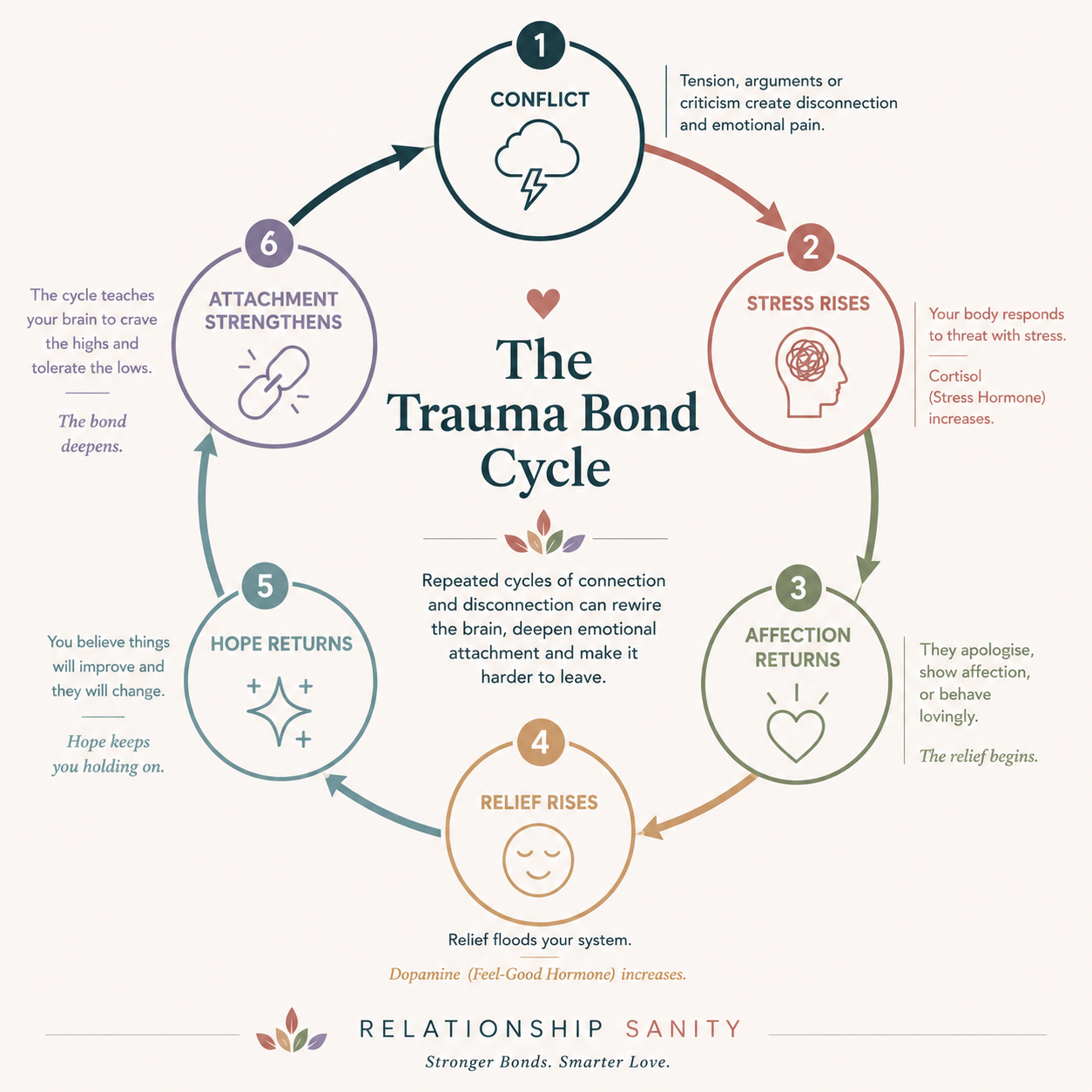
Imagine a relationship in which one person becomes increasingly critical and distant. After a period of tension, there is an argument, perhaps followed by rejection or emotional withdrawal. Then something changes. The partner apologises, becomes affectionate again, promises that things will be different, or simply returns to the loving person they were during the early stages of the relationship.
The relief can be enormous.
And that relief matters psychologically. When distress is followed unpredictably by affection, reassurance or connection, the positive experience can become particularly powerful because it arrives after something painful and because you cannot predict exactly when it will come again. You may find yourself waiting for the next good period, holding onto memories of how wonderful things can be, or interpreting each improvement as evidence that the relationship is finally changing.
This is where the idea of intermittent reinforcement becomes important. In behavioural psychology, reinforcement that occurs unpredictably can produce persistent behaviour because the person never knows exactly when the rewarding experience will appear. In the context of a relationship, affection and relief may become intertwined with distress and uncertainty, creating a cycle that can be extraordinarily difficult to step away from.
The good moments are not necessarily fake. That is one of the uncomfortable complications.
You may genuinely love the person. You may have experienced real tenderness, laughter, intimacy and connection together. You may have seen a side of them that other people never see, or experienced periods when you were convinced that the relationship had finally turned a corner. The fact that those moments were real does not cancel out the harm, but the reality of the good moments can make the decision to leave much more emotionally complicated.
You are not simply walking away from pain. You may also feel that you are walking away from the possibility of getting the good relationship back.
Why knowing isn’t always enough
This is where the question Why can’t I just leave? becomes particularly important.
We often assume that once someone understands that a relationship is harmful, the logical next step should follow naturally. But human beings don’t make relationship decisions using logic alone. Attachment, fear, hope, familiarity, loneliness, practical dependence and emotional history can all influence what feels possible, even when our conscious mind is telling us that something needs to change.
There can also be a profound conflict between different parts of the person. One part may be saying, I can’t keep living like this, while another is thinking, But what if things really are different this time? One part may remember the worst experiences clearly, while another is flooded with memories of the moments when the relationship felt safe and loving. Neither side is necessarily imaginary.
This can create a particularly painful form of self-doubt. You may leave and then miss the person intensely. You may feel relieved one day and devastated the next. You may remember the reasons you left and then find yourself questioning whether you exaggerated them. You may even find yourself wanting comfort from the same person you were trying to escape.
That contradiction can be frightening, but it doesn’t automatically mean that leaving was the wrong decision.
It may mean that attachment doesn’t disappear simply because a decision has been made.
The brain doesn’t simply choose what is logical
There is a common assumption that if the rational part of the brain understands something, the rest of us should fall into line. Relationships don’t work that neatly. The systems involved in attachment and emotional learning develop over time, and repeated experiences can create powerful associations between a person, a particular emotional state and the relief that follows distress.
This is one reason intermittent reinforcement can be so compelling. If affection arrives after periods of rejection, your emotional system may become highly attentive to signs that connection is returning. The anticipation of relief can become part of the cycle itself. You may find yourself watching for a change in tone, a message, an apology or some small indication that the person you love has come back.
That doesn’t mean you are addicted to the person in a simplistic sense, and it doesn’t mean your feelings are proof that the relationship is healthy. It means that repeated emotional experiences can shape behaviour and attachment in ways that are not easily overridden by a single rational conclusion.
This is also why telling someone, “You know they’re bad for you, so just leave,” can be so unhelpful. The statement assumes that knowing and doing are the same psychological process. They aren’t.
Sometimes the person already knows.
What they may not yet understand is why knowing hasn’t been enough.
When the relationship starts changing your sense of yourself
One of the more damaging aspects of a trauma bond is what can happen to self-trust over time. If you repeatedly experience affection followed by rejection, promises followed by disappointment, or reassurance followed by another painful incident, you may begin questioning your own interpretation of events.
Perhaps you are told that something didn’t happen the way you remember it. Perhaps you are made to feel unreasonable for objecting to behaviour that once would have seemed obviously unacceptable. Perhaps every conflict ends with you wondering whether you caused the problem, overreacted or expected too much.
None of this means that every disagreement or contradictory account is evidence of manipulation. Relationships are messy, memories are imperfect, and people genuinely experience the same event differently. The concern arises when a repeated pattern leaves you increasingly unable to trust your own perceptions, needs and judgement.
You may start asking other people what they think before trusting your own reaction. You may spend hours analysing conversations. You may find yourself collecting evidence that your feelings are justified. You may even become so focused on understanding the other person’s behaviour that you have very little attention left for the question of what the relationship is doing to you.
That is an important point in understanding trauma bonds. The problem isn’t simply that you remain attached to someone who hurts you. Over time, the cycle can begin to affect your confidence in your ability to judge the relationship at all.
Hope can be part of the bond
Hope is often treated as though it is automatically positive. In most circumstances, it is. Hope can help people endure difficult periods, imagine a different future and remain open to change.
In a trauma bond, however, hope can become intertwined with the cycle itself.
The relationship may have been wonderful at the beginning. Perhaps you remember exactly how attentive they were, how connected you felt, how intensely they seemed to understand you. Or perhaps there are still occasional periods when everything becomes good again, sometimes so good that you start believing the difficult parts were an aberration rather than part of a larger pattern.
It is understandable to hold onto that possibility. You are not necessarily hoping for something imaginary; you may be hoping for the return of something you genuinely experienced.
This is one reason leaving can involve grief even when you know the relationship was harmful. You may not only be grieving the person. You may be grieving the future you imagined, the version of the relationship you kept hoping would return, and the version of yourself that existed when you still believed the two of you could make it work.
That grief can coexist with knowing that leaving was necessary.
The two things don’t cancel each other out.
So why can’t I just leave?
Perhaps the more useful question is slightly different.
Instead of asking, What’s wrong with me that I can’t leave?, it may be more revealing to ask, What’s happening in this relationship that makes leaving so difficult?
That change in the question matters because it moves the focus away from personal failure and towards understanding the dynamic. You can begin looking at the cycles of connection and distress, the periods of relief that follow painful experiences, the hope that keeps being renewed, the fears that arise when you imagine leaving, and the ways your confidence in your own judgement may have changed.
You may also begin to notice how much of your attention has become organised around the other person’s behaviour. Are you watching their mood before deciding how to behave? Are you waiting for the next apology? Are you constantly trying to work out which version of the relationship you are going to get? Have you become more focused on preventing the next conflict than on asking what you actually want from your life?
Those questions aren’t a test you have to pass before you are allowed to call something a trauma bond. They are simply ways of looking more closely at what is happening. The label itself is less important than understanding the pattern and what it may be doing to your ability to make choices in your own interests.
From confusion to clarity
Learning about trauma bonding isn’t about giving yourself another label or finding someone to blame. It can be a way of replacing a deeply personal question—What’s wrong with me?—with a more useful one: What’s happening here?
That distinction can change the quality of the conversation you are having with yourself. Instead of treating your attachment as evidence that you are weak or irrational, you can begin to understand that attachment, hope, fear and repeated reinforcement may all be influencing your decisions at the same time. You can still take responsibility for your choices without pretending that those choices are being made in an emotional vacuum.
Understanding a trauma bond will not automatically tell you whether to stay or leave. There are practical realities, safety considerations, financial circumstances, children, housing, support networks and many other factors that can make leaving a relationship far more complicated than simply making up your mind. In some situations, leaving can also carry genuine risks, which is another reason simplistic advice about “just walking away” can be inadequate.
What understanding can provide is something that may have been missing for a long time: an explanation for the conflict between what you know and what you feel.
Once that conflict begins to make more sense, there may be a little less energy spent asking why you can’t simply behave differently. You can start paying attention to the pattern itself, to the effect it is having on you and to the parts of your own judgement that you may have stopped trusting.
That doesn’t make the next decision easy.
It can make the decision more understandable.
The Relationship Sanity perspective
A trauma bond isn’t evidence that you are stupid, weak or incapable of making good decisions. It is a description of a powerful relational dynamic in which attachment, distress, hope, uncertainty and relief can become intertwined over time, sometimes making a harmful relationship feel extraordinarily difficult to leave.
Understanding that doesn’t mean excusing harmful behaviour, and it doesn’t mean that everyone who struggles to leave a difficult relationship has a trauma bond. The term should be used thoughtfully rather than as a diagnosis that explains every painful relationship. What matters is whether the concept helps you understand something about your own experience that previously didn’t make sense.
At Relationship Sanity, we are interested in that movement from confusion towards clearer understanding. When you can recognise the cycle rather than judging yourself for being caught in it, you may be better placed to notice what is happening, strengthen your boundaries, seek appropriate support and begin rebuilding trust in your own judgement.
You don’t have to answer the entire question of your future today. Sometimes the first useful step is simply being able to look at what is happening without immediately turning the blame back on yourself.
Ready to understand your own experience more deeply?
If you suspect that you may be caught in a trauma bond dynamic, the Relationship Sanity Trauma Bond Self-Assessment is available as a free resource to help you explore the patterns more closely. It isn’t intended to diagnose you or make a relationship decision for you; it is a starting point for understanding what you may be experiencing.
You can also explore the Know Yourself First Journal, which is designed to help strengthen self-awareness, develop greater self-trust and become more conscious of the patterns influencing your relationship decisions.
Because sometimes the first step towards making a different choice isn’t forcing yourself to leave.
It is finally understanding why leaving has felt so difficult.