Self-awareness and boundaries
When Curiosity Goes Too Far: Find Balance with Boundaries

Curiosity is generally considered a strength, and for good reason. It encourages us to look beyond our first assumptions, to become interested in our own reactions, and to understand other people rather than immediately judging them. In relationships especially, curiosity can be valuable because human behaviour is rarely as straightforward as it first appears; someone can be distant because they are angry, frightened, exhausted, distracted or dealing with something that has very little to do with us. The willingness to wonder about what we don’t yet know can prevent us from turning an interpretation into a fact before we have enough information.
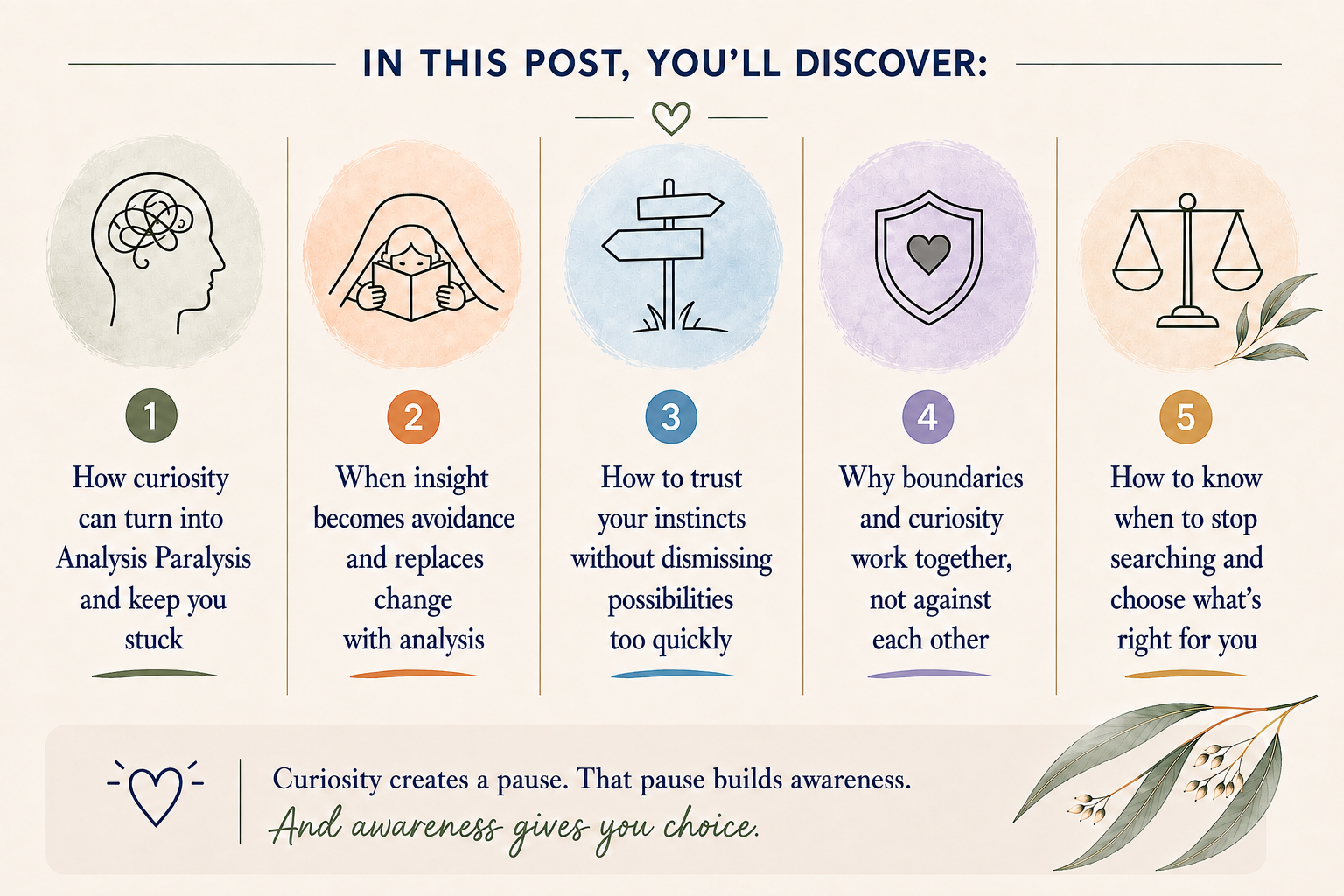
But there is a less comfortable side to curiosity. Sometimes the search for understanding becomes so absorbing that we lose sight of what we are actually experiencing, what we need, or what we are willing to accept. We can analyse someone’s behaviour for months without asking whether the behaviour itself is working for us, or spend so much time examining our own reaction that we never decide what we want to do about the situation. Curiosity can become a way of keeping a difficult question open indefinitely, particularly when closing the question would require us to make a decision we would rather postpone.
So the useful question isn’t simply whether we are being curious. It is whether our curiosity is helping us see more clearly, or whether it has quietly become another way of staying stuck.
When curiosity becomes overthinking
Imagine you are involved with someone whose behaviour is inconsistent. Some days they are warm, attentive and engaged; on others they pull away, become difficult to reach or seem emotionally unavailable. It is entirely natural to want to understand what is going on, and there may be many plausible explanations: perhaps they are afraid of intimacy, perhaps they have had difficult experiences, perhaps they are uncertain about what they want, or perhaps they simply have a very different capacity for closeness from the one you need. The problem isn’t that you are asking those questions; the problem begins when the questions keep multiplying while your understanding of the actual situation doesn’t seem to change.
You might start replaying conversations, looking for clues in messages, asking friends for their interpretations, reading about attachment styles and reconsidering every interaction in light of the latest explanation. Because you are thinking so deeply, it can feel as though you are doing important psychological work. Yet after several weeks you may still be in exactly the same position, wondering what the other person means, what they are feeling and what might happen next, without having decided what their behaviour means for you.
There is a difference between curiosity that opens something up and analysis that simply keeps circling it. Useful curiosity usually gives you something you didn’t have before: new information, a different perspective, a better understanding of your own response, or a possibility you had genuinely overlooked. Overthinking tends to produce variations of the same question, often accompanied by the feeling that if you could just think about it for a little longer, certainty would eventually arrive.
Sometimes it won’t.
The more uncomfortable possibility is that you may already know enough to make a decision, but you don’t like what the available information requires you to consider. Continuing to analyse can then become a way of postponing that decision without having to admit that you are postponing it. The mind remains busy, the investigation continues, and you get to feel as though you are still gathering information when what you may actually be doing is waiting for the situation to become easier than it is.
When insight becomes a hiding place
There is a form of avoidance that can look remarkably psychologically sophisticated. You can know your attachment style, understand your triggers, recognise your childhood patterns and explain exactly why you become anxious, defensive or avoidant in particular situations, and all of that knowledge can be genuinely useful. But psychological insight and behavioural change are not the same thing, and sometimes understanding a pattern can become a substitute for doing something about it.
You might know that you avoid difficult conversations because conflict makes you anxious, yet continue avoiding the conversation. You might understand why you repeatedly stay too long in relationships that aren’t working, but continue staying. You might recognise that you people-please because you learned early that keeping other people happy was safer than expressing your own needs, while still finding yourself saying yes when you mean no. The explanation matters, but eventually there comes a point when the more important question is what you are going to do with the explanation.
Curiosity is particularly easy to remain inside because it doesn’t require us to commit to an outcome. As long as we are still examining the situation, there is another possibility to consider and another piece of information that might change our minds. Action is different because it closes some doors, even when we know the decision is the right one.
This is why insight without action can become strangely comfortable. We can become experts in explaining the life we aren’t changing.
That doesn’t mean every insight needs to produce immediate action. Sometimes understanding has to develop before we are ready to do anything differently, and sometimes the most useful thing we can do is wait rather than force a decision. The point is simply that curiosity is supposed to help us understand our experience well enough to make conscious choices, not provide an endless reason to delay choosing.
When curiosity starts overriding your own experience
There is another problem that can arise when curiosity becomes excessive, particularly for people who have learned to distrust their own perceptions. Something happens and your immediate reaction is that it doesn’t feel right, but instead of becoming interested in that reaction, you immediately begin looking for reasons why it might be wrong. Perhaps you’re being too sensitive, perhaps the other person didn’t mean it that way, perhaps you are projecting something from the past, or perhaps there is an explanation you haven’t considered.
Those are all reasonable possibilities, and sometimes they will be important. We don’t always interpret situations accurately, particularly when something has activated an old fear or familiar relationship pattern. The difficulty comes when curiosity becomes a one-way investigation in which every piece of information is used to challenge your own perception while the other person’s behaviour is repeatedly given the benefit of the doubt.
Your instincts are not infallible, but they are still information. A feeling that something is wrong doesn’t necessarily tell you exactly what is wrong, and it doesn’t prove that your interpretation is correct, but it does tell you that something in your experience deserves attention. You can investigate that signal without immediately obeying it, just as you can question it without automatically dismissing it.
This is where self-trust becomes more nuanced than simply believing yourself. Self-trust doesn’t mean assuming that your first reaction is always accurate; it means trusting yourself enough to listen to the reaction, examine it honestly and remain capable of making a decision once you’ve considered the evidence. If curiosity always ends with you talking yourself out of what you felt in the first place, it isn’t strengthening self-awareness anymore.
Sometimes curiosity will show you that an old fear was colouring your interpretation. Sometimes it will show you that your discomfort was justified, that someone really did cross a line, or that a situation is not healthy for you. The purpose of curiosity is not to make either outcome more likely; it is to help you distinguish between them.
The search for the perfect answer
Curiosity can also become tangled up with our desire for certainty. We may want to know exactly why someone behaves as they do, exactly what they feel about us, exactly what will happen if we stay, leave, speak up or change the relationship. Unfortunately, human relationships rarely provide that kind of certainty because other people are complicated, contradictory and sometimes uncertain about themselves.
Someone can love you and still behave badly. Someone can have a perfectly understandable reason for their behaviour and still be incapable of giving you the relationship you need. Someone can be frightened of intimacy and genuinely care about you at the same time, but their fear does not automatically make the relationship workable.
This is where curiosity can start asking a question that reality cannot answer: What explanation would finally make me certain? There may not be one, and continuing to search for it can keep you waiting for a level of certainty that no human relationship can provide.
You might never know exactly why a partner keeps pulling away, but you may know that the inconsistency is making you unhappy. You may not know whether a colleague respects you, but you may know that the way they speak to you isn’t acceptable. You may never fully understand why a friendship changed, but you may know that the friendship has stopped feeling reciprocal.
Most decisions are made with incomplete information. What matters is not reaching some imaginary point at which every question has been answered, but recognising when you have enough information to make a reasonable decision while accepting that some uncertainty will remain.
Curiosity isn’t supposed to eliminate uncertainty. It is supposed to help us become more capable of living and choosing within it.
Where boundaries enter the picture
Curiosity and boundaries can initially seem like opposing ideas. Curiosity opens a situation up and asks questions, while a boundary establishes a limit and says that something is or isn’t acceptable to us. In practice, though, they can work together extremely well, because a boundary gives curiosity somewhere to stand.
Consider Carrie Bradshaw’s relationship with Mr. Big in Sex and the City. Carrie spends a great deal of time trying to understand his emotional distance, his inconsistency and his reluctance to commit, and her curiosity is understandable because she wants the relationship to make sense. The difficulty is that understanding him sometimes becomes more important than asking whether his behaviour is actually compatible with what she needs from a relationship.
Now imagine the same curiosity existing alongside a clear internal boundary: I’m curious about why he pulls away, but I also know that I don’t want a relationship characterised by inconsistency. The question can remain open without the answer determining whether she is willing to tolerate the behaviour.
That distinction matters outside romantic relationships as well. You can be curious about why a friend repeatedly cancels plans while still deciding that you need more reciprocity. You can understand why a family member becomes angry while still refusing to participate in conversations that become abusive. You can be interested in the reasons behind someone’s behaviour without turning those reasons into an obligation to remain available to them.
Understanding is not the same thing as excusing, and it certainly isn’t the same thing as consenting to continued behaviour.
What comes first: curiosity or boundaries?
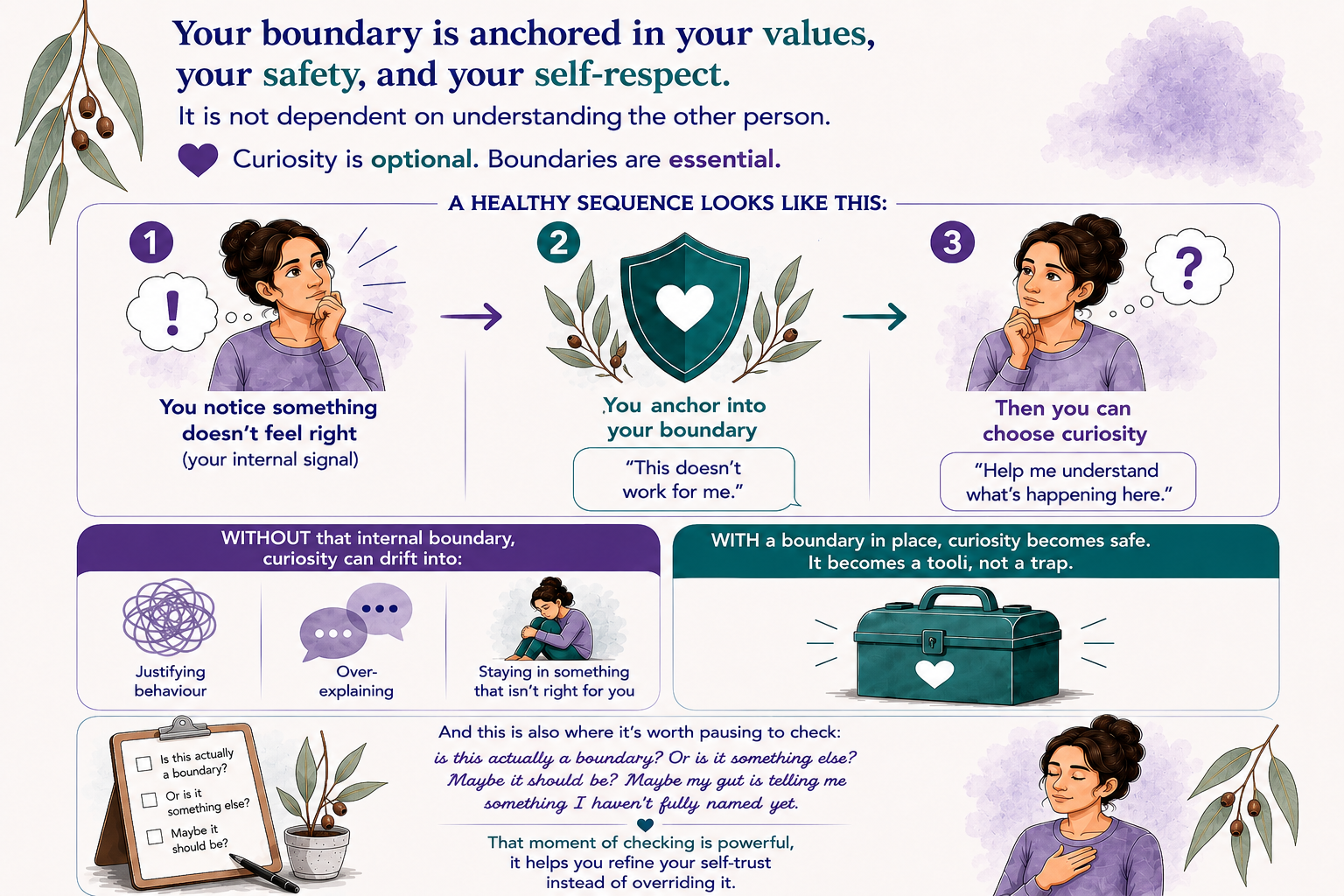
The boundary doesn’t necessarily have to be spoken first, but an internal sense of what matters to you can make curiosity much safer. If something feels wrong, you don’t need to know exactly why before acknowledging that reaction; you can recognise that something has been activated and become curious about it while still holding onto the possibility that your needs or limits may matter regardless of the explanation.
You might ask yourself, If this is what is happening, is it okay with me? That question doesn’t require you to have solved the entire situation, and it doesn’t prevent you from hearing another person’s perspective. It simply establishes that the other person’s explanation isn’t going to be the only information that matters.
From there, you can ask, Can you help me understand what is happening here? If their answer makes sense, you have more information. If their answer doesn’t make sense, or if their behaviour continues despite the conversation, you haven’t lost your position because your boundary wasn’t dependent on receiving the perfect explanation.
There is also room for curiosity to turn inward and examine the boundary itself. Sometimes what we initially call a boundary is actually fear, an old expectation or a preference we have never really questioned, and understanding that can strengthen rather than weaken self-trust. The important difference is whether you are examining your boundary because you genuinely want to understand yourself better, or because another person’s behaviour has made you uncomfortable and you feel compelled to prove that your own response is unreasonable.
A healthy boundary can survive curiosity. It doesn’t need to be protected from questions in order to remain valid.
Why curiosity can change our response
There is a psychological reason curiosity can be useful when we are emotionally activated. When something feels threatening, overwhelming or personally significant, the nervous system can move quickly into protective responses such as fight, flight, freeze or fawn; we may become angry and defensive, withdraw from the situation, shut down, or start trying to keep another person happy. These responses are not character defects, and they aren’t simply bad choices made by people who lack emotional intelligence; they are ways the nervous system can respond when something feels unsafe or overwhelming.
You will sometimes hear this explained as the amygdala taking over while the prefrontal cortex switches off, but the actual neuroscience is more complicated than that popular description suggests. The useful principle is that deliberate attention can interrupt automatic responding and give reflective processes more opportunity to influence what happens next. When you notice what you are feeling, identify what has activated you and become interested in what your mind is telling you, you may create enough distance to consider whether your first impulse is actually the response you want to make.
That doesn’t mean curiosity will make you calm. You can become curious about your anger and remain angry, or understand why you are frightened and still decide that something needs to change. The purpose of the pause isn’t to make you more tolerant of behaviour you find unacceptable; it is to give you a better chance of choosing your response rather than discovering afterwards that your reaction chose it for you.
In that sense, curiosity creates a pause, but the pause is not the destination. What matters is what becomes possible because you had that moment of awareness.
What curiosity with boundaries sounds like
In real life, this combination is rarely as neat as a psychological model makes it sound. It might sound like, “Help me understand what you meant by that,” followed by, “I hear what you’re saying, but I’m not okay with being spoken to like that.” It might mean telling someone, “I want to understand what happened, but I need some time before we continue this conversation,” because you know that trying to resolve everything while emotionally flooded is unlikely to produce a useful result.
The important part is the position underneath the words: I am willing to hear more, and I am still paying attention to what happens to me while I do. You can listen without agreeing, reconsider an assumption without dismissing your feelings, and understand someone’s perspective without taking responsibility for their behaviour.
Sometimes curiosity will lead you towards repair. Sometimes it will reveal a misunderstanding that can be resolved quite easily. Sometimes it will show you that the problem is more serious than you initially realised, and that the appropriate response is distance, a firmer boundary or an ending rather than another conversation.
Curiosity does not determine the outcome. It helps you see enough of the situation to choose one.
Knowing when to stop asking
Perhaps one of the most useful forms of curiosity is knowing when the investigation is finished. You may have asked reasonable questions, listened to the other person’s explanation, considered alternative interpretations and looked honestly at your own contribution, and there may come a point when continuing to analyse produces no new information. At that stage, the mind can start using uncertainty itself as a reason to keep thinking.
There is a difference between a question that opens something up and a question that sends you around the same circle. What am I missing? can be useful when there is genuinely something you haven’t considered, and What else could be true? can broaden your perspective when you have become overly certain. But if you have asked those questions repeatedly and are still waiting for an explanation that will remove every doubt, you may no longer be looking for understanding; you may be looking for a guarantee.
Relationships don’t offer guarantees.
Sometimes the most self-trusting position is simply, I don’t know everything about this situation, but I know enough about how it affects me to decide what I want to do. That isn’t perfect certainty, and it isn’t pretending that there are no unanswered questions. It is recognising that unanswered questions don’t always have to prevent action.
Holding curiosity and boundaries together
The goal isn’t to become less curious. It is to become more discerning about when curiosity is helping and when it has started doing something else, because the same behaviour can look quite different depending on what is happening underneath it.
When curiosity is useful, it expands your understanding. You become interested in your own reactions, question assumptions, listen to another person’s experience and remain open to information that might genuinely change your mind. When it becomes analysis paralysis, it keeps you circling the same material; when it becomes avoidance, it allows you to understand without acting; and when it repeatedly overrides your instincts, it can gradually weaken your confidence in your own perceptions.
Boundaries give curiosity a place to stop. They allow you to say, in effect, I am willing to learn more about this, but I am not willing to abandon what matters to me while I do.
That is a more grounded form of openness. You can ask questions and still say no, seek understanding and still step back, discover that your first interpretation was wrong without deciding that your feelings were foolish, or discover that your discomfort was justified without needing to turn the other person into a villain.
Curiosity helps you understand the situation. Boundaries help you decide what to do about it, and neither one has to cancel out the other.
When you find yourself going around in circles
The next time you notice that you have been thinking about a situation for hours, days or even weeks, it may be worth becoming curious about the thinking itself. Are you actually discovering something new, or are you replaying the same material in increasingly complicated forms? Are you looking for understanding, or hoping that one more explanation will make a difficult decision disappear? Are you genuinely considering another perspective, or are you searching for reasons not to trust what you already know?
Those questions don’t require a perfect answer. Sometimes noticing the pattern is enough to change the next step, because you may suddenly realise that what you need isn’t another article, another conversation or another round of analysis but some distance from the problem, a decision you’ve been postponing, or a boundary you haven’t yet acknowledged.
And sometimes you really do need more information. Curiosity should leave room for that possibility too, because the alternative to overthinking isn’t rushing into certainty. The aim is to know the difference between gathering information and repeatedly searching for information that will make uncertainty disappear.
You may discover that you know enough. You may discover that you need to ask something directly. You may discover that you need to wait and see what happens rather than constructing an explanation in advance. Or you may discover something about yourself that changes the way you understand the whole situation.
The important thing is that curiosity eventually takes you somewhere.
The Relationship Sanity perspective
Curiosity is valuable because it helps us see more than our first reaction, but it isn’t valuable simply because it keeps us asking questions. There are times when understanding is exactly what we need, and there are other times when we already understand enough and need the courage to act on what we know. The skill lies in becoming able to tell the difference.
Curiosity can help you recognise a reaction before acting from it, question an assumption without dismissing your instincts, understand another person’s experience without excusing their behaviour, and gather information without demanding absolute certainty. Boundaries add another kind of intelligence to that process because they remind us that understanding someone else’s experience does not mean handing them responsibility for deciding what is acceptable in ours.
The Relationship Sanity framework is therefore less about choosing between curiosity and boundaries than learning how to hold them together. You can remain open while being clear about your limits, and you can examine your own assumptions without treating your own experience as something that has to be argued away.
Curiosity helps you understand. Boundaries help you decide.
Sometimes the most useful thing curiosity gives you is a new explanation. Sometimes it gives you a new perspective on yourself. And sometimes, perhaps most importantly, it gives you enough information to realise that you don’t need another explanation before you make the decision you have been avoiding.
Continue your journey
If you want to explore this further, the Know Yourself First Journal is designed to help you build self-trust, strengthen self-awareness and turn curiosity into greater clarity and action. The journal also includes the Curiosity or Analysis Paralysis? self-assessment, which can help you recognise when reflection is useful and when it may have become a loop.
The Curiosity Workbooks are also available separately if you want to explore the subject in more depth. Because curiosity isn’t simply about asking better questions; it is about becoming more capable of recognising what the answers are telling you and deciding what you want to do with them.